
Télémétrie des cuves de propane : prenez les devants avant l’hiver | Four Data
Résumé
7 min read · Updated 13 August 2026
Dans cet article
- What European gas stocks reveal in mid-August 2026
- Why this macro signal concerns propane distributors
- Down to tank level: the data to surface
- Smoothing delivery rounds before the seasonal rise in demand
- How FOUR DATA connects existing propane fleets
- After deployment: from reactive to anticipated dispatching
- FAQ
Propane tank telemetry means measuring the level and days-of-autonomy of an LPG tank remotely with a connected sensor, then transmitting that data to a supervision platform. FOUR DATA links the sensor, the connectivity, the Desk or Sens platform and the alerts, to turn a level measurement into a delivery decision.
In mid-August 2026, European natural gas stocks stand at their lowest level for the season in almost eighteen years, around 59% full according to Gas Infrastructure Europe. Brussels has relaxed the winter target from 90% to 80%, the sign of a market under strain.
For a propane distributor, this backdrop is not just energy news. It signals a demanding heating season, in which every poorly calibrated delivery and every emergency weighs more heavily on the margin. Tank telemetry then becomes a concrete steering lever.
Key figure
In France, the industry counts around 800,000 propane tanks in service, above-ground and buried combined, for close to 11 million LPG customers according to France Gaz Liquides — and a significant share of that fleet is still managed through customer calls, control rounds or manual readings.
Ce que révèlent les stocks de gaz européens à la mi-août 2026
The signal is clear. On 9 August 2026, the European Union’s gas storage sites were about 59% full, up from 57% in early August according to the AGSI+ aggregated inventory. Bloomberg describes a seasonal low unseen in almost two decades. The injection season had started very low, at 28% full on 1 April, a weaker starting point than the previous three summers.
Sources : Gas Infrastructure Europe (inventaire agrégé AGSI+), données au 9 août 2026 ; objectif de remplissage assoupli à 80 % (ACER).
The EU Agency for the Cooperation of Energy Regulators (ACER) notes that refilling storage before winter will require higher LNG imports than in past years. The regulator also recalls that European regulation now allows a relaxed fill target, brought down to 80%. High prices, driven in part by tensions in the Middle East, partly explain this injection delay.
Note
These figures concern pipeline natural gas, not propane in tanks. The distinction matters. But the energy market works as communicating vessels: a tight winter on natural gas translates into nervous prices and heating demand that is harder to anticipate across all fuels, propane included.
Pourquoi ce signal macroéconomique concerne-t-il les distributeurs de propane ?
A low gas inventory does not empty your customers’ tanks. It does, however, change the cost of uncertainty. When energy is expensive and heating demand concentrates into a few cold weeks, an under-filled delivery round or an emergency delivery eats into an already compressed margin.
This organisation by calls and readings holds while volumes stay small. It quickly reaches its limits once an operator manages several hundred tanks spread across a territory. The symptoms are familiar to operations managers:
- under-filled delivery rounds;
- costly emergencies;
- data scattered across tools and readings;
- a lack of visibility for customer service.
On a sensitive, regulated product like LPG, this uncertainty becomes an operational and commercial issue.
« The real issue is not fitting a gauge, it is knowing which tank to deliver first. Ahead of winter, the question an operator asks is where my autonomy margins are and where my run-out risks are. »
— Quentin Gauthray, Key Accounts Manager France at FOUR DATA
Jusqu’au niveau de la cuve : les données à mettre en évidence
Anticipating a heating season means replacing estimates with measurement. Three data points change the way a propane fleet is managed:
- the real level of each tank, measured by a sensor fitted to the existing gauge, often a Rochester type, and certified for ATEX environments;
- the forecast days-of-autonomy, computed from observed consumption, which tells how many days remain before a critical threshold;
- configurable alert thresholds, which trigger a notification before the tank reaches a low level.
« On a fleet of several hundred tanks, the autonomy data is often worth more than the level data, » says Quentin Gauthray. Two tanks filled to the same percentage do not carry the same urgency: the one feeding a high-consumption site will empty far faster. It is this reading by autonomy, not by simple percentage, that makes it possible to sequence deliveries.
Lisser les tournées de livraison avant la hausse saisonnière de la demande
The value of reliable data shows on the delivery round. An LPG delivery costs on average 65 euros, and an emergency intervention far more. By moving the truck fill rate of its rounds from 45% to 70%, a distributor running 10,000 deliveries a year can save up to 232,000 euros in direct costs. This modelling is detailed on our page dedicated to the connected gas gauge for propane.
Modélisation Four Data — taux de remplissage des camions passant de 45 % à 70 % ; réduction des ruptures de stock pouvant atteindre 35 % observée sur les flottes équipées, en fonction du contexte propre à chaque opérateur.
The mechanism is simple. Knowing real levels, the operator groups deliveries by geographic area, fills trucks better and removes control trips. Emergencies become rarer because they are anticipated. Before winter, this smoothing frees logistics capacity at the very moment demand concentrates.
The benefit should be stated carefully: telemetry does not remove every run-out or every emergency. It reduces uncertainty and gives planners more reliable data to decide with. On fleets equipped with smart sensors, FOUR DATA observes a run-out reduction of up to 35%, an order of magnitude that remains dependent on each operator’s context.
Comment Four Data connecte les flottes fonctionnant au propane existantes
FOUR DATA designs and deploys a complete chain: sensor, connectivity, platform and support. This integration sets the company apart from hardware-only or software-only players. The sensor measures the level, the connectivity (NB-IoT, LTE-M, LoRaWAN or Sigfox) transmits the data even in rural areas, and the platform makes it usable.
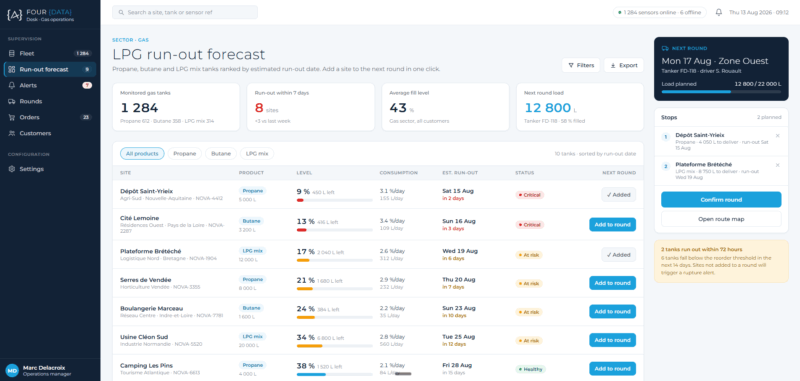
Two platforms cover distinct needs. Desk centralises operational supervision for the operator, with a multi-site view, history and alerts. Sens is used as a white label to give end customers a digital interface. Everything integrates with an existing ERP via API, avoiding a proliferation of isolated tools. The approach is detailed on our page on remote tank monitoring.
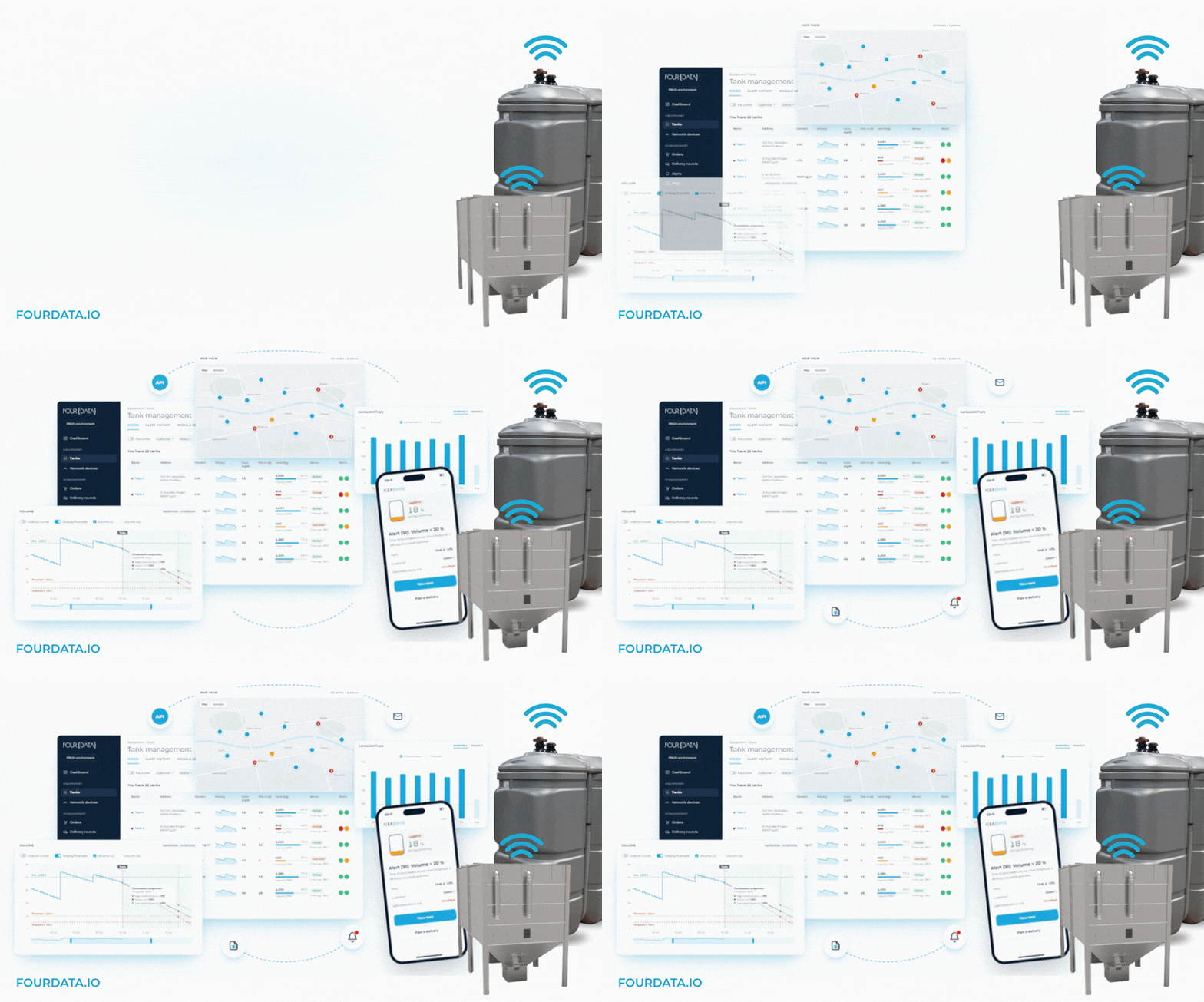
The FOUR DATA chain — from the sensor fitted to the existing gauge to the delivery decision, through the Desk (operator) and Sens (end client) platforms, ERP-integrable via API.
Attention
The gradual 2G and 3G network sunset across Europe is making part of the older remote-reading units obsolete — often installed on Rochester gauges and dependent on those networks. Replacing that equipment with sensors communicating over NB-IoT or LTE-M secures measurement continuity for the long term.
For a distributor, modernising a propane fleet becomes the opportunity to make both the data and the communication link reliable, before the heating season mobilises every team. The stakes of the switch-off are detailed in our article on the 2G sunset and LPG tank monitoring.
In the field, most propane tanks can be equipped without heavy work, the sensor connecting to the existing mechanical gauge. For a mixed fleet, the same logic applies to other containers — heating oil tanks, lubricant tanks or biofuel reservoirs — as explained in our guide on connected tank solutions and which IoT technology to choose.
Expert advice
We connect the sensor to the existing Rochester gauge, with no structural modification of the tank, and we select the connectivity site by site — NB-IoT, LTE-M, LoRaWAN or Sigfox — according to location and the expected reporting frequency, to guarantee reliable transmission even in dead zones.
For bottle stocks and gas racks, a neighbouring use case is worth noting. The OptiTrack Vision camera sensor counts and measures rack filling remotely with an autonomous smart camera. The principle mirrors tank telemetry: turning a field measurement into usable data.
Après le déploiement : passer d’une gestion réactive à une gestion anticipée des interventions
- fleet tracked through customer calls, control rounds and manual readings;
- delivery rounds prepared from estimates;
- emergencies endured, costly for the margin;
- customer service with no visibility on levels.
- delivery rounds prepared from real levels;
- emergencies prioritised instead of endured;
- alert thresholds that cut manual checks;
- customer service that communicates earlier.
Once the fleet is connected, teams change posture. Delivery rounds are prepared from real levels rather than estimates. Emergencies are prioritised instead of endured. Alert thresholds cut the reliance on manual checks, and customer service gains the visibility to communicate earlier.
This feedback shows among distributors already equipped. In Belgium, FOUR DATA supports the distributor Nielen Joseph in optimising its heating oil and gas delivery rounds, with connected gauges installed on customer tanks. Remote level supervision enables better planning and a reduction in unnecessary kilometres.
The approach stays the same whatever the market: measure, transmit, supervise, alert, then optimise. Entering winter with that visibility means entering the heating season anticipating rather than reacting.
FAQ
Faites vérifier votre parc de cuves de propane avant l’hiver
The heating season is prepared now. FOUR DATA teams can audit your fleet, identify the priority tanks and propose a sensor, connectivity and platform architecture fitted to your field constraints.
Article updated on 13 August 2026. Written with the expertise of Quentin Gauthray, Key Accounts Manager France at FOUR DATA, who supports gas distributors in optimising their delivery rounds.
Ces articles pourraient également vous intéresser :