
Monitoring van pelletvoorraad voor appartementencomplexen | Four Data
Samenvatting
9 min read · Published on 24/09/2026
In dit artikel
- Why pellet stock is the weak point of collective wood heating
- How do you monitor a pellet silo level remotely?
- What the property manager actually sees
- On the ground: a Swiss distributor’s experience
- The right questions before equipping a building portfolio
- FAQ: pellet stock monitoring in apartment buildings
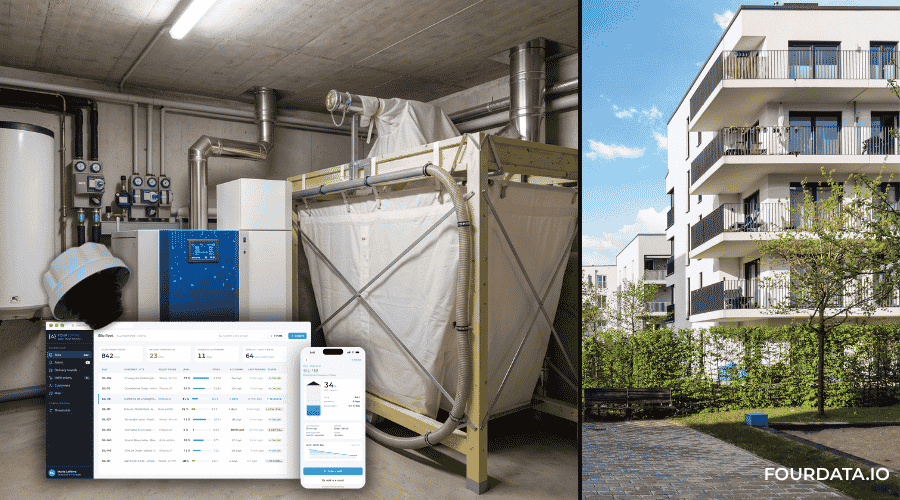
An apartment building heated with pellets is a sound energy choice, and an increasingly common one. It is also a very concrete responsibility for the property manager: if the silo runs empty without anyone noticing, the boiler stops and the whole building loses heating and hot water. Often on a Friday evening in January.
Between random manual readings, tenants calling in and a supplier who has to be brought in urgently, pellet stock monitoring in co-owned buildings still relies far too often on improvisation.
This guide reviews the monitoring methods available and explains how property managers move from reactive stock management to planned stock management.
Key figure
A pellet distributor equipped with connected gauges reports up to 32% logistics savings by planning delivery rounds on actual silo levels instead of estimates.
Waarom de pelletvoorraad het zwakke punt is van collectieve houtverwarming
In a boiler room running on gas, or connected to a district network, supply is continuous. With pellets, it is discontinuous: the fuel is stored on site, in a silo whose capacity covers a few weeks to a few months of consumption. The reliability of the whole heating system therefore depends on a single question: is there enough left in the silo?
That question is surprisingly hard to settle. Consumption varies sharply with the weather. The surface of the pellets inside the silo is never flat, which makes visual estimates misleading. And the storage room is not always easy to access, nor visited regularly.
Note
A building that runs six weeks on one silo in November can empty the same silo in three weeks during a cold snap. Any schedule that ignores the weather ends up caught out.
As a result, most property managers work either on a calendar basis (ordering every two months) or reactively (the caretaker has a look from time to time). Both methods end up producing the same incident: an unanticipated run-out, a boiler in lockout, and a restart that may require a technician once the silo has been refilled.
The cost of an outage goes far beyond the price of an emergency delivery. It includes the supplier’s exceptional call-out, a possible visit from the heating contractor to restart the installation, the hours spent handling calls from occupants, and a damaged relationship with tenants or co-owners. For a firm managing several pellet-heated buildings, that risk multiplies with every site.
Hoe monitort u het niveau van een pelletsilo op afstand?
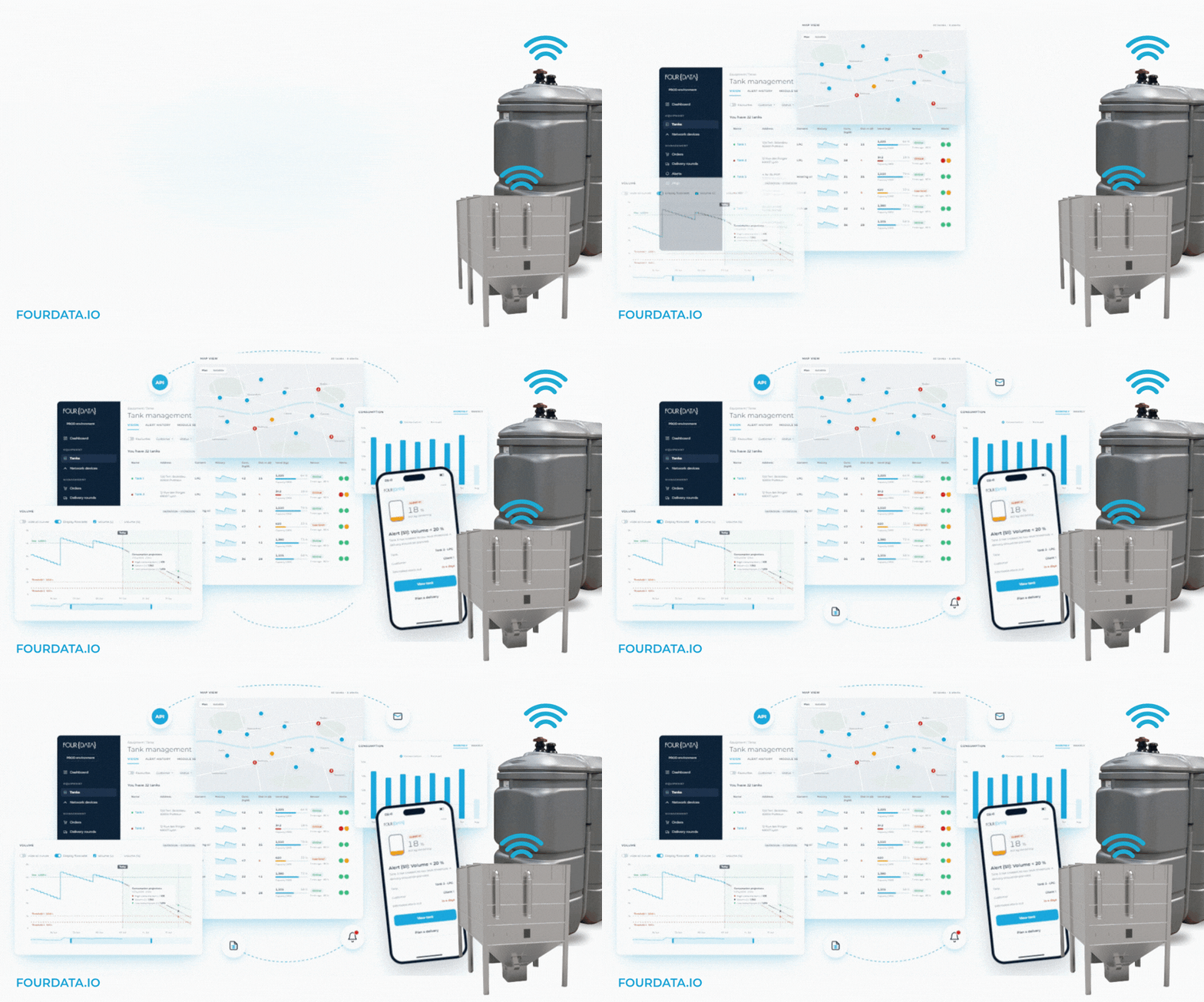
To monitor a pellet silo level remotely, a connected gauge is installed on top of the silo. The sensor measures the level several times a day, transmits the data over an IoT network and triggers an email or SMS alert before the stock runs out.
This simple principle changes the nature of the property manager’s work: instead of checking, they are notified. Here is how the approach compares with the traditional methods.
Drie monitoringmethoden vergeleken
| Method | Reliability | Workload | Anticipation |
|---|---|---|---|
| Visual reading (caretaker, technician) | Low: irregular surface, estimated by eye | One trip per reading, on every site | None between two visits |
| Calendar-based ordering (fixed dates) | Medium: ignores weather and consumption swings | Low, but emergencies to handle in winter | Theoretical, caught out by cold snaps |
| Connected gauge (radar measurement) | High: non-contact measurement, several readings a day | No travel, levels checked on screen | Threshold alerts and emptying trend |
Attention
If the silo runs completely empty, the boiler goes into lockout and the building is left without heating or hot water. Restarting after refilling may require a technician’s visit.
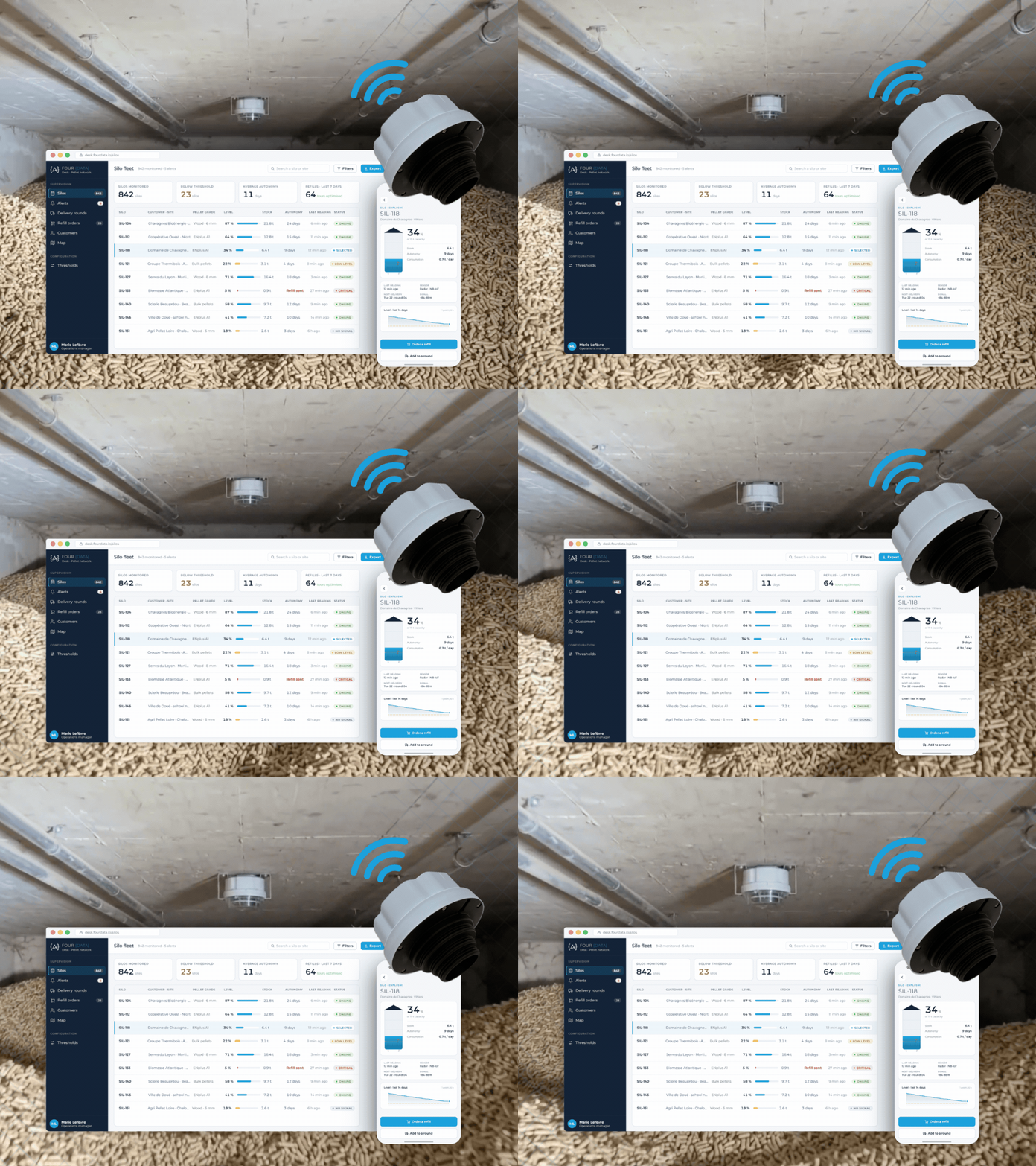
Radar measurement deserves a technical note. Pellets are a solid, dusty material with an irregular surface: conventional measurement technologies reach their limits there. Radar technology passes through dust and moisture, and is not disturbed by the metal walls of the silo. It is the technology used by NOVA RADAR, Four Data’s connected gauge for pellet silos, designed precisely for these environments. The sensor runs on battery for several years and transmits its readings over the NB-IoT or LTE-M networks, with no wiring and no Wi-Fi needed in the boiler room.
Remote pellet stock monitoring: from the silo to the property manager’s screen
Wat de vastgoedbeheerder daadwerkelijk ziet
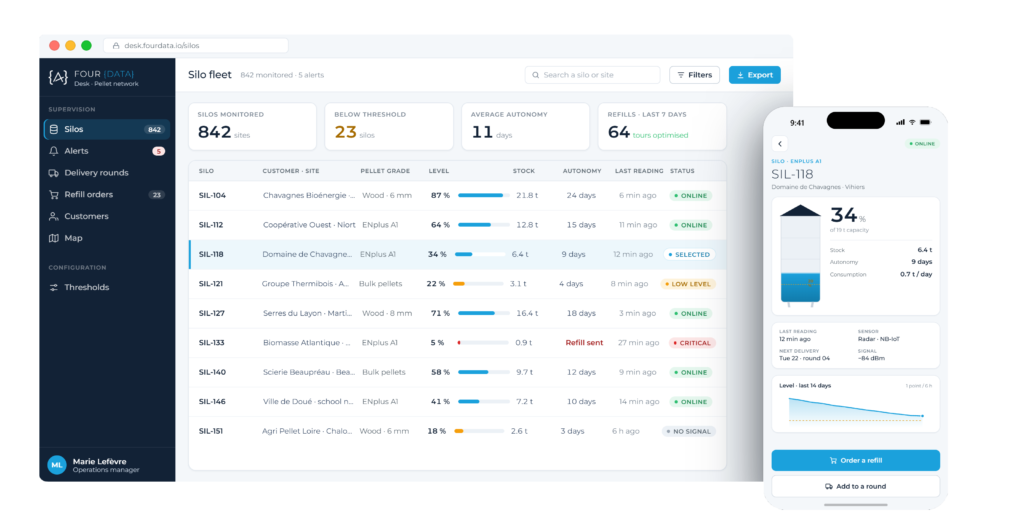
Once the silo is equipped, each building has its own page on the supervision platform: level as a percentage, consumption curve, delivery history and an emptying trend that projects the date of the next order. The whole portfolio can be checked from a single screen, on a computer or a smartphone.
Expert advice
We recommend a two-threshold setup: a first alert at 30% to place an order under normal conditions, and a second at 15% that flags a situation to handle as a priority.
Alert thresholds are configured to match the constraints of each building, and notifications go out by email or SMS to the designated contacts, which can include the pellet supplier directly.
This is where the system becomes genuinely interesting for a property manager: replenishment can be delegated to the supplier, who sees the levels of the silos he supplies and plans his deliveries before the critical thresholds. The manager steps out of the role of intermediary who monitors, orders and chases. They keep the visibility, the supplier handles the flow.
Managing buildings in Switzerland? The NOVA RADAR sensor is distributed and installed there by a single provider: discover the connected pellet silo in Switzerland with Belet Citernes.

In de praktijk: de ervaring van een Zwitserse distributeur
This way of working is not theoretical. In French-speaking Switzerland, Guignard, a distributor of heating oil and pellets, has been equipping its customers’ silos with Four Data sensors since last winter. Its director draws a direct conclusion from it: remote level monitoring simplifies delivery planning and makes supply needs easier to anticipate. His customers no longer have to think about their pellet levels and entrust him with the full management of their replenishments. The full story is in the Guignard case study.
That experience led, in September 2026, to a structuring partnership for the Swiss market: Belet Citernes, a tank manufacturer based in Penthalaz, has become the exclusive distributor and installer of the NOVA RADAR sensor on pellet silos, throughout Switzerland. For a property manager, this means a local contact who supplies the sensor, installs it and commissions it, with no multi-provider coordination. The details of the offer are on the page dedicated to the NOVA RADAR gauge installed by Belet Citernes.
At a wider scale, Four Data has around 80,000 sensors deployed across Europe with energy distributors and industrial operators, on fuel tanks, gas tanks and silos.
Figures from Four Data deployments with energy distributors and industrial operators in Europe
De juiste vragen voordat u een gebouwenportefeuille uitrust
Three criteria to frame a connected monitoring project across a portfolio of co-owned buildings:
- The silo configuration. Masonry silos, hoppers, fabric silos: radar measurement adapts to most configurations, but a survey of the portfolio validates the installation on each site. In Switzerland, pellet storage is governed by the SICC HE 200-01 directive on room ventilation, whose principles are echoed in the proPellets.ch storage guide; a professional installer factors in these constraints.
- The decision loop. Who receives the alerts and who places the orders? The property manager alone, the caretaker, or the supplier under delegation? The system works in all three setups, but it is worth deciding before the installation.
- Network coverage. Boiler rooms are often in basements. The NB-IoT and LTE-M networks penetrate buildings well, and a coverage test before deployment removes any doubt on sensitive sites.
FAQ: monitoring van pelletvoorraad in appartementencomplexen
Stap over van reactief beheer naar gepland beheer
Pellet stock monitoring should not depend on a trip to the boiler room or a bet on the weather. With a connected gauge, the property manager sees the levels, receives the alerts and lets the supplier deliver at the right time.
This article was written with the expert input of David Rotaru, Key Account Manager for Switzerland and Germany at Four Data, who supports energy distributors and DACH market players with their telemetry projects.
Misschien vind je deze artikelen ook interessant: