
Inventory monitoring – definition, challenges and IoT solutions
Inventory monitoring is an important task for more and more companies that need to maintain a complete overview of their stock levels during ongoing operations. This article explains what inventory monitoring is, what its challenges are and how modern technologies and IoT solutions enable effective inventory monitoring in the supply chain.
What does inventory monitoring mean?
Definition of inventory monitoring
Inventory monitoring is the continuous process by which companies monitor their stocks, quantities, conditions and locations of products and materials. It enables companies to maintain an up-to-date overview of stock levels at all times and make informed decisions during ongoing operations. The aim is to create transparency about existing stock levels and to identify deviations at an early stage.
Tasks and scope of inventory monitoring
Inventory monitoring fulfills a central operational role in the company and comprises several tasks along the entire warehouse and material flow:
- Monitoring of current stock levels
- Avoidance of bottlenecks and shortages
- Reduction of excess stock and storage costs
- Ensuring the traceability of products
- Support for efficient planning
- Current and reliable data
- Clear overview of stocks and locations
- Early warnings in the event of deviations
- Support for daily work in the warehouse
Differentiation from inventory control, inventory management and inventory controlling
| Concept | Target | Frequency | Level |
|---|---|---|---|
| Inventory monitoring | Create transparency | continuous | operational |
| Inventory control | Check deviations | periodically | operational |
| Inventory management | Manage stocks | regularly | tactically |
| Inventory controlling | Analyze costs | periodically | strategically |
Goals and challenges of inventory monitoring
Optimization of stock levels and costs
A key objective of inventory monitoring is to optimize stock levels while simultaneously reducing storage costs. Targeted inventory management helps companies to reduce tied-up capital and make better use of resources. Continuous analysis of stock levels makes it possible to avoid overstocking and to make investments at the right time.
- Reduction of capital commitment
- Avoidance of overstocking
- More efficient use of storage space
Ensuring availability and service level
Effective inventory monitoring ensures that products and materials are available at all times without incurring unnecessary storage costs. It supports stable production operations and contributes directly to customer satisfaction by avoiding supply bottlenecks. At the same time, it improves the ability to plan along the supply chain and increases the ability to react to fluctuations in demand.
Challenges due to increasing SKU, lack of transparency and fluctuations in demand
Companies are increasingly facing complex challenges in inventory monitoring:
- Increasing number of products and variants (SKU)
- Lack of transparency about current stocks
- Unforeseeable changes in demand
- Manual processes with high effort
Organization and process of inventory monitoring
Manual vs. digital inventory monitoring
In many companies, inventory monitoring is still carried out manually, for example using Excel lists or paper-based processes. This method is time-consuming and prone to errors. Digital systems, on the other hand, enable automated recording and updating of inventories and create a reliable basis for decisions in day-to-day operations.
| Manual | Digital |
|---|---|
| High maintenance effort | Automatic updating |
| Error-prone | Higher accuracy |
| Limited transparency | Central overview |
Real-time monitoring of stocks
Monitoring stock levels in real time allows companies to know their current stock levels at all times. Deviations are detected immediately, allowing them to react more quickly and reduce operational risks. Especially in dynamic environments, real-time transparency increases planning reliability and supports precise process control.
Mobile and cross-location inventory monitoring
Mobile solutions enable access to inventory data regardless of location. This allows companies to maintain an overview at all times, especially if they have several warehouses or distributed teams. Employees can record or check stock levels on site without being tied to fixed workstations.
Technologies for efficient inventory monitoring
Inventory monitoring software and automation
Modern inventory monitoring software helps companies to centrally record, monitor and analyze stock levels. Automated functions such as alerts, reports or interfaces to existing systems reduce manual effort and improve transparency throughout inventory management.
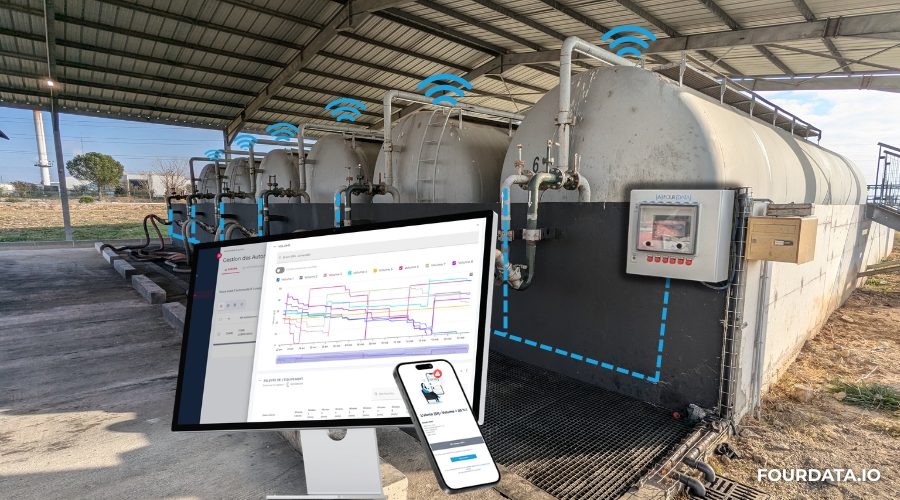
IoT sensors for monitoring fill level, position and temperature
IoT sensors enable automated and continuous recording of physical inventory data and are particularly suitable for industrial applications:
- Level measurement of containers, silos or tanks
- Positioning of goods and systems
- Temperature monitoring of sensitive products
Barcode, QR code and RFID technologies
Barcode, QR code and RFID solutions complement IoT systems and are often used to identify and track products. They support structured inventory management and are particularly suitable for processes with many items and regular movements.
Data analysis and AI for decision support
Data analysis and AI help to make sensible use of inventory data. Patterns are recognized, requirements are predicted and automatic warnings are triggered, for example in the event of impending bottlenecks. This allows processes to be optimized and decisions to be made based on data.
IoT-based inventory monitoring – our approach at Four Data
Why IoT is fundamentally changing inventory monitoring
IoT technologies are fundamentally changing inventory monitoring by enabling continuous, automated collection of inventory data. In contrast to traditional approaches, IoT provides precise information in real time and thus creates the basis for effective inventory monitoring during ongoing operations.
Our IoT management platform for smart objects
We are developing a modular IoT management platform that enables companies to centrally monitor their inventories, systems and products. Our approach is open to all technologies and supports different sensors, networks and use cases along the supply chain.
Data acquisition, visualization and integration (ERP, SAP, APIs)
Our solutions enable the structured collection and visualization of data and can be seamlessly integrated into existing IT systems. The connection to ERP, SAP or API interfaces ensures that inventory data can be used throughout the entire company.
Scalable solutions for industry, logistics and energy
- Industry and production
- Logistics and warehouse management
- Energy, tanks and silos
FAQ on inventory monitoring
You may also be interested in these articles :