
Propane gas fill level indicator – monitor fill level safely
Summary
- Why is monitoring important?
- Measuring the fill level of gas tanks and racks – Professional methods
- The Four Data solution: networked platform
- Which solution is the right one? Purchase criteria
- Intelligent gas monitoring with IoT – Our solution at Four Data
- FAQ – Frequently asked questions about the propane gas level indicator
A professional fill level indicator for gas tanks and cylinder bundles is the key to efficient logistics. Whether stationary liquid gas tanks (LPG) in commercial use or mobile gas racks in industry – if you want to avoid empty tanks and expensive production downtime, you need more than just an estimate.
In this article, we show you how to precisely determine the gas level in tanks and bundles. We compare methods for professional use – from the analog percentage display on the tank to modern IoT solutions such as AI-supported camera systems (OCR) and smart tank gauges that send data directly to the cloud.
Why is monitoring important?
Risks and safety aspects
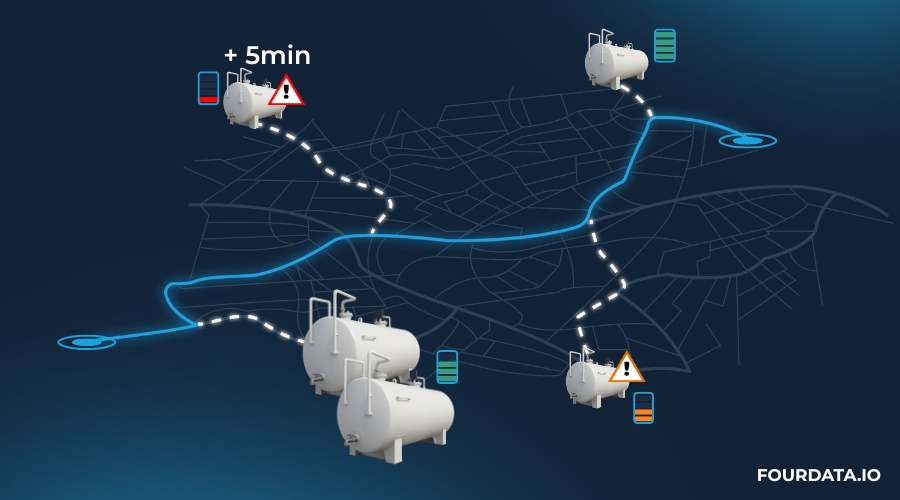
For gas suppliers and industrial consumers, an empty tank or an empty rack often means expensive downtime. Precise monitoring offers decisive advantages over manual monitoring: security of supply (automatic reordering by VMI), logistics optimization (route planning based on actual fill levels instead of forecasts) and transparency (accurate billing and fast detection of leaks).
Typical areas of application
Professional level indicators are essential for:
- Industry: Process heat and production reliability
- Agriculture: Supply of barn heating or drying systems
- Logistics: Tracking of mobile gas racks and bundles
Economic impact and security of supply
An unnoticed vacancy causes expensive production downtimes and deliveries of electricity at special rates. For gas suppliers, a missing Level indicator on tanks or racks inefficient logistics: trucks arrive with half-full tanks or arrive too late. The solution is transparent data transmission in real time.
Measuring the fill level of gas tanks and racks – Professional methods
If you want to determine the fill level of industrial containers, you cannot rely on home remedies. Three technologies that combine precision with economy have become established in the professional environment:
1. the standard: mechanical content indicator (gas tank)
Mechanical measurement is common for above-ground and underground gas tanks. A float in the tank magnetically transmits the level to a percentage scale (often a Rochester display). This method is robust, but requires an on-site reading, which ties up personnel.
Advantage: Robust, de-energized, ATEX-compliant.
Disadvantage: No remote monitoring possible (without retrofitting).
2. the smart solution: IoT level probes (Four Data)
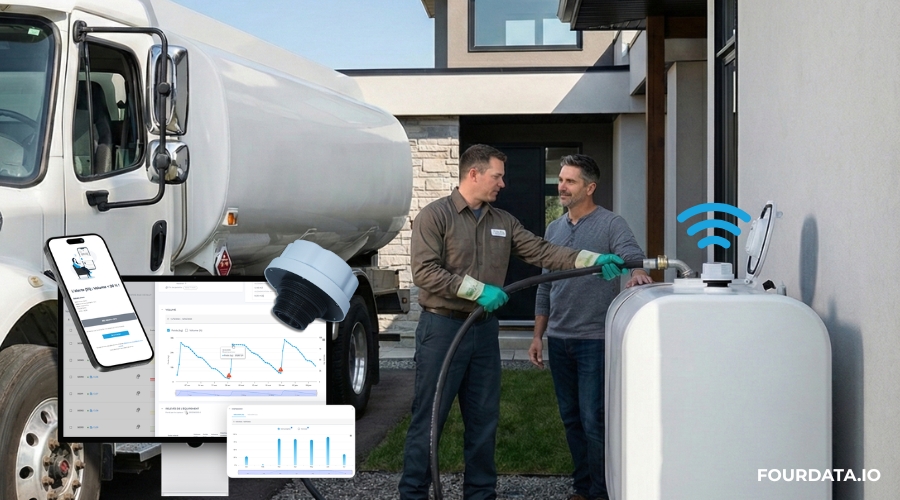
A smart sensor (networked measuring device) is clipped directly onto the mechanical display of the tank (retrofit). It digitizes the pointer reading and transmits the data via networks such as Sigfox or LoRaWAN.
| Feature | Analog (mechanical) | Digital (IoT) |
|---|---|---|
| Meter reading | On site (manual) | Remote monitoring (app/web) |
| Data frequency | Sporadically | Continuous (e.g. 4x daily) |
Ideal for:
Gas suppliers who manage customer tanks remotely to prevent “run-outs”.
3rd innovation for racks: Optical OCR measurement
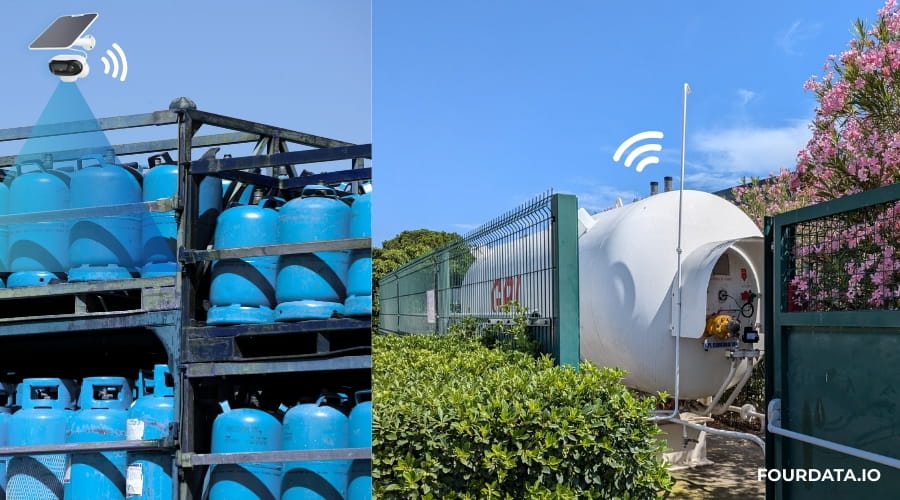
A revolution for gas cylinder bundles (racks)Since racks often have analog pressure gauges, systems such as Optitrack Vision a camera. An AI reads the dial optically and transmits the value digitally. This makes even mobile “dumb” racks smart and locatable.
Advantages and limitations of the measurement methods
| Method | Accuracy | Effort | IoT-capable |
|---|---|---|---|
| Mechanical float | Medium (+/- 5%) | High (reading on site) | No |
| IoT probe (Four Data) | High (+/- 2%) | Low (remote maintenance) | Yes |
| Optical OCR (camera) | High (digital) | Medium (rack mount) | Yes + GPS |
The Four Data solution: networked platform
In addition to the hardware, data evaluation is also crucial. A modern Level indicator is now part of a networked system.
4. the platform: all data centrally in view
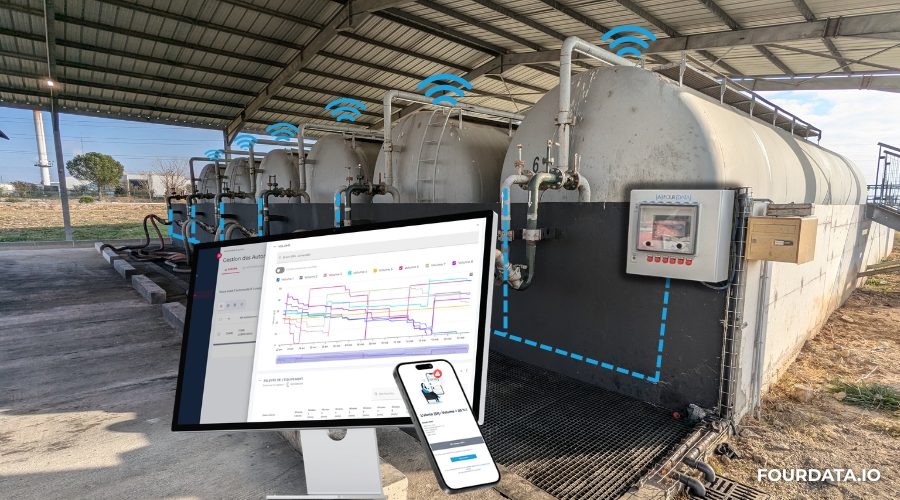
The hardware is only the first step. A professional cloud platform collects all data from tanks and racks. It enables automatic orders (VMI), alerts for critical levels and export functions for your ERP system.
Typical functions:
- Geolocation: Where are my racks located?
- Consumption history and forecast
- Route optimization for tankers
Which solution is the right one? Purchase criteria
Choosing the right level indicator depends on your infrastructure.
| Requirement | Recommended solution | Advantage |
|---|---|---|
| Stationary tanks (above/underground) | Networked measuring device | Simple retrofitting to Rochester |
| Mobile gas racks & bundles | Optitrack Vision (OCR) | GPS tracking included |
| Distribution networks | Four Data Platform | Central logistics control |
Accuracy and reliability
While manual methods depend on the user, digital digital measuring devices stable results. IoT solutions also enable continuous monitoring of the gas level and eliminate reading errors.
Installation effort
Four Data’s networked measuring device can be installed in just a few minutes using “clip-on”, without interfering with the gas pressure. Optitrack Vision can also be installed in racks without the need for complex cabling.
ROI and profitability
The decisive factor is not just the purchase price, but also the long-term benefits. By avoiding emergency deliveries and optimizing routes, IoT systems often pay for themselves in less than a year.
Solution for utilities and industry
Companies with several gas tanks benefit from automated monitoring and centralized remote display.
Checklist before purchase:
- Check tank type (above/underground)
- Network availability (Sigfox/LoRaWAN)
- Need for ATEX certification
- API interface requirements for ERP
Intelligent gas monitoring with IoT – Our solution at Four Data
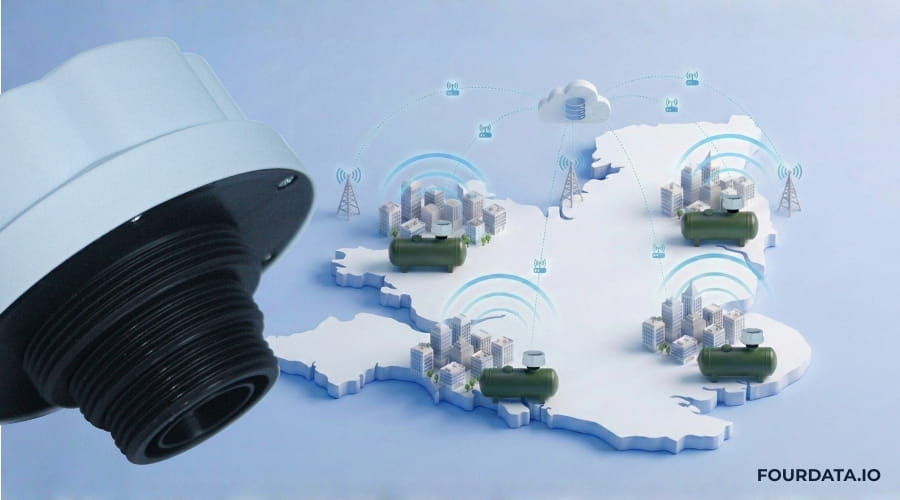
As an IoT specialist, we develop networked solutions for the precise monitoring of gas cylinders, stationary gas containers and industrial plants. Our systems record the fill level automated and provide the data centrally.
Four Data is revolutionizing gas logistics with two core technologies:
1. for gas tanks (networked measuring device): Our sensor simply clicks onto the existing Rochester scale of your gas tank (underground or above ground). It installs in minutes, is ATEX-certified and transmits accurate levels for up to 10 years without battery replacement.
2. for gas racks (Optitrack Vision): This system revolutionizes the management of mobile bundles. It reads the analog dials of the racks using OCR technology and transmits the data. This means you always know where your racks are located (geolocation) and how full they are.
Integration into ERP, BI and management systems
We integrate the measurement data directly into existing ERP, BI or monitoring systems. The evaluation takes place via dashboard or via appso that managers can keep track of several locations at the same time.
Scalable solutions for industry, oil & gas and agriculture
Our platform has a modular design and is suitable for both individual systems and large networks with many gas cylinders. gas cylinders. We create transparent processes and optimized repeat orders, particularly in industry, oil & gas and agriculture.
From sensor integration to the IoT data platform – everything from a single source
We support projects from hardware integration to secure data processing. Sensor technology, connectivity and platform come from a single source and are tailored to the specific requirements of the application.
FAQ – Frequently asked questions about the propane gas level indicator
You may also be interested in these articles :