
Route optimization – efficient route planning through data and technology
Summary
- What is route optimization and why is it crucial today?
- Goals and added value of route optimization
- Framework conditions for successful route optimization
- How does route optimization work in practice?
- Route optimization with software, IoT and real-time data
- FAQ – Frequently asked questions about route optimization
- Conclusion – route optimization as a data-driven competitive advantage
Today, route optimization is a key lever for companies that want to manage tours, routes and resources efficiently. The aim is to save time, reduce mileage and cut costs sustainably with the help of modern route optimization and route planning.
This is no longer just about a single tour, but about holistic optimization that takes many parameters into account: vehicles, time slots, areas and data. Modern solutions make it possible to automatically calculate and continuously improve routes – based on up-to-date information and powerful algorithms. This turns classic planning into a data-driven solution for time and efficiency.
What is route optimization and why is it crucial today?
Route optimization refers to the process in which routes, tours and assignments are planned and adjusted so that time, costs and resources are used in the best possible way. It goes far beyond simple route planning and is based on the systematic optimization of routes, taking into account many parameters such as time windows, capacities, areas or operational restrictions. The aim is to create optimized routes that work reliably in everyday operations.
In order to clearly classify the term, it is worth making a distinction:
- Route: the specific distance between several stops
- Tour: a complete sequence of stops for a driver or vehicle
- Tour planning: the organization and assignment of tours
- Route optimization: the data-based improvement of this planning
Manual planning quickly reaches its limits. Increasing numbers of vehicles, changes at short notice or the last mile can hardly be mapped efficiently without algorithms. This is precisely where route optimization becomes crucial.
Typical areas of application are logistics and transportation, technical field service, service assignments, delivery and mobile technicians in various areas.
Goals and added value of route optimization
The objectives of route optimization can be clearly classified along the operational value chain. The focus is on reducing costs, followed by more efficient operational management, an improved customer experience and positive effects on the environment and sustainability.
- Cost reduction: fewer kilometers driven, lower fuel consumption and reduced operating costs per driver and vehicle.
- Operational efficiency: better utilization of the number of vehicles, structured route planning in transport and clearly distributed tasks.
- Service quality: more reliable delivery times, transparent information for customers and better planning of assignments.
- Sustainability: Reduced CO₂ emissions thanks to optimized tours and efficient use of resources.
| Problem | Benefits through route optimization |
|---|---|
| High operating costs | Reduction of time and costs |
| Unclear planning | Central control and transparency |
Framework conditions for successful route optimization
Efficient route optimization must be able to process a large number of complex framework conditions simultaneously. Optimized routes can only be calculated realistically and reliably if all relevant factors are taken into account.
Geographical structure and distances
Different areas, distances and road networks directly influence travel times and the optimum sequence of stops.
Time windows, priorities and order types
For example, fixed delivery times, prioritized customers, same-day service calls or different stops per route.
Vehicles, capacities and resources
Different vehicles with different capacities, ranges or types of use must be included in the planning.
Traffic, disruptions and external events
Current traffic situations, roadworks or short-term events require dynamic optimization in real time.
Data quality and timeliness
Only accurate, up-to-date and complete data enables reliable optimization.
How does route optimization work in practice?
In practice, route optimization follows a structured process that combines planning and optimization and continuously adapts to new circumstances. The aim is to calculate tours efficiently in a short time and to improve them permanently.
- Data collection and consolidation
Relevant information such as addresses, orders, time slots, vehicles or available resources are collected and standardized centrally. - Optimization algorithms and AI logic
Tours are calculated automatically on the basis of algorithms and artificial intelligence, taking numerous parameters into account simultaneously. - Simulations and scenarios
Different variants are simulated in order to find the best possible solution for different requirements. - Static vs. dynamic route optimization
While static planning takes place in advance, dynamic optimization adapts to changes in real time. - Continuous improvement through feedback data
Real usage data is analyzed and enables a continuous increase in efficiency.
Route optimization with software, IoT and real-time data
Modern software for route optimization plays a central role when tours and routes not only have to be planned, but also continuously adapted. Such solutions automatically analyze complex parameters and enable an optimized tour even with many stops, vehicles or areas. Traditional tools such as Google Maps quickly reach their limits in professional use: they do not take into account operational restrictions or real-time data from the field.
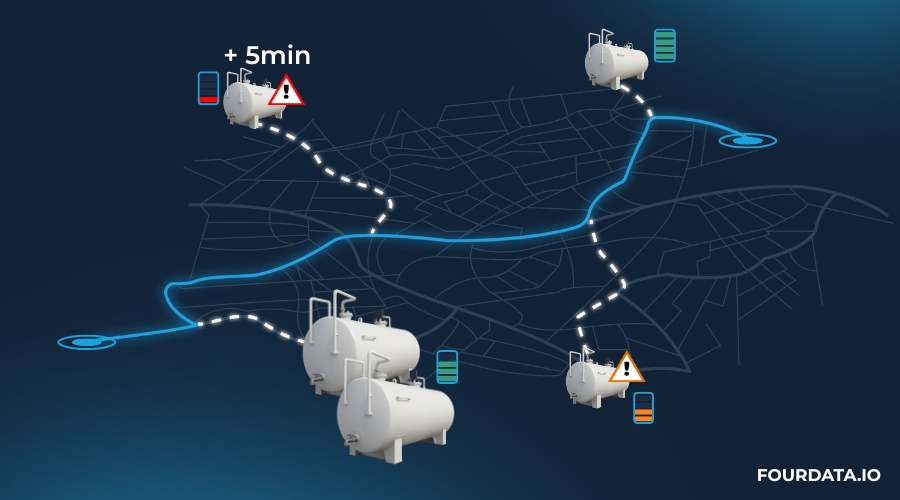
This is exactly where IoT and real-time data unfold their added value. Networked devices, GPS and sensor technology allow tours to be dynamically controlled and optimized based on current data.
Typical IoT contributions to route optimization:
- GPS data for precise location determination
- Real-time information on vehicle status and operations
- Event-based adjustment in the event of faults or delays
FAQ – Frequently asked questions about route optimization
Conclusion – route optimization as a data-driven competitive advantage
Today, route optimization is much more than just a planning task. It combines efficiency, cost control and service quality to create a measurable competitive advantage. Companies that rely on data-based optimization can control their routes flexibly and react to changes. In addition, networked, scalable solutions open up new opportunities for transparency and continuous improvement.
At Four Data, we support companies in taking this step – with an approach that intelligently combines IoT, connectivity and data analysis.
You may also be interested in these articles :