
Fuel distributors: energy transition, biofuel and field data

Summary
10 min reading – Published May 18, 2026 – Updated May 18, 2026
Contents
The Strait of Hormuz closed, and in a matter of days the price of diesel soared, while fuel distributors saw their order books swing in all directions. April 2026 was a stark reminder to France’s 800 fuel distributors that their business depends on a supply chain over which they have no control. But the real issue, the one that will decide who survives in ten years’ time, is not the price of a barrel of oil. It’s the ability to transform.
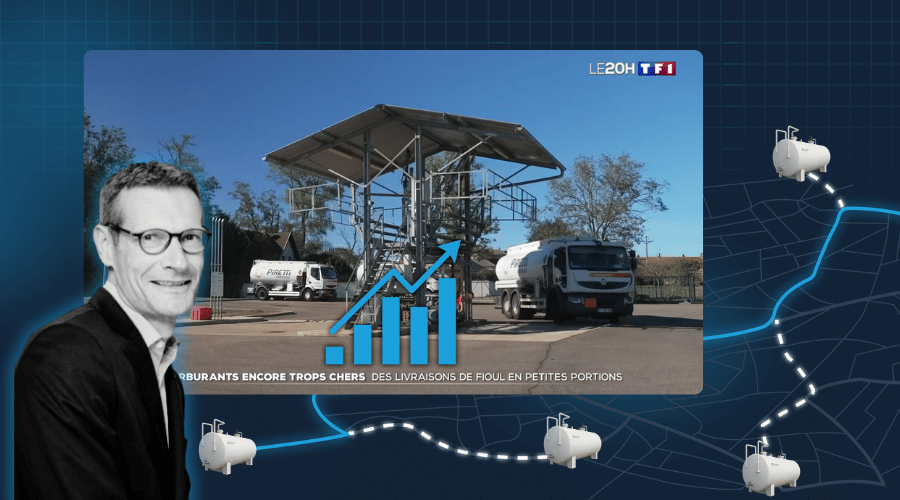
We spoke to Jacques Goisque, General Manager of the Fédération Française des Combustibles, Carburants et Chauffage (FF3C), to find out more. Since January 2025, he has been at the helm of a union with just under 800 members, working with regional unions across the country. His diagnosis is straightforward, and in line with what we observe in the field with the distributors we equip.
Key figure
There are around 800 fuel distribution companies in France. The FF3C, headed by Jacques Goisque since January 2025, federates just under 800 of them, and coordinates local unions throughout the country.
A sector under stress: what the geopolitical shock has revealed
The scenario was played out in two stages. First, panic. “Members had been working very hard, and had received a lot of orders very quickly,” explains Jacques Goisque. The reflex effect: to secure product whatever the price, for fear of a shortage. Then came the turnaround. Prices rose sharply, demand dried up as quickly as it had soared, and activity fell back – except for the farming community, which picked up again in April but remained cautious.
Importantly, and counter-intuitively, there were no supply shortages. “We have stock, there’s no problem with product shortages, but we have products that are very high.” The shockwave passed through price, not volume. And it hit diesel harder than petrol, because France imports a large proportion of its finished products. This dependence on imports explains the price differential that motorists have noticed at the pump.
Note
No supply disruptions during the shock of April 2026: the stock was there, it was the price that soared. The shockwave passed through price, not volume – a distinction that changes the way you manage your purchasing.
The government responded with an electrification plan. The industry expected something different. “Economic players were looking for short-term solutions, not a 10, 15 or 20-year electrification plan,” sums up Jacques Goisque. The political horizon and the operational horizon are not set at the same tempo.
Biofuel, a concrete commitment to the industry
What are biofioul F30 and biofioul F100?
Biofioul is a heating fuel that incorporates esters of renewable origin into conventional fuel oil. F30 contains 30% esters and is already in use with distributors. The F55, with 55% esters, is due to be ramped up next year. The F100, a 100% renewable fuel, is in the process of being standardized, with tests deemed conclusive.
This is where the future of distributors lies, and Jacques Goisque makes no secret of the fact. The trajectory is set: from the current F30 to the F55, and then on to the F100. The tests carried out to standardize the F55 and F100 are, in his words, “very conclusive so far”.
What does this mean in concrete terms for a distributor? Multi-product management is becoming the norm. The same fleet of customer tanks may hold conventional fuel oil, or F30, or tomorrow F55. Keeping track of which product is in which tank, at what level, becomes a daily operational issue – not a reporting detail. This is exactly the kind of complexity that field data can absorb, as we’ll come back to below.
Concentration and the “last mile”: retailers restructure
The picture of the sector has already changed. The concentration of players has been going on for a long time: fewer, more structured companies, larger distribution volumes. On the other hand, consumption of fossil fuels is declining. But – and this is the point the distributors want to make – this decline is slow and steady. We’ll still need heating oil in five to ten years’ time.
Jacques Goisque then poses the real strategic question, that of the “last metre”:
“There will also be the question of the last mile, when we have to deliver the last liter of fuel oil. That’s why we want the government to support our companies in this downsizing, because there are jobs and companies behind it.”
– Jacques Goisque, General Manager of FF3C
The economic challenge for the business over the next decade will be to deliver profitably to a shrinking volume of customers in an increasingly dispersed territory. The service station network is following the same trend. A survey quoted by Jacques Goisque points to a decline in the number of service stations, to the point where some communes are buying them up to maintain service to their constituents. Fewer distribution points mean longer journeys and a service that has to be defended kilometer by kilometer.
Profitable distribution on declining volumes depends on just one thing: no more empty runs and no more early deliveries. It’s mechanical.
Attention
Every underfilled round or unanticipated emergency delivery eats into a margin already under pressure. With volume declining, logistical errors can no longer be made up for in terms of sales.
Do you distribute heating oil or RNG and your rounds still run according to schedule rather than actual levels? Let’s discuss your oil tank supervision project – we’ll take a look at your fleet and your constraints in the field.
FF3C points to field data as leverage
The last topic of the interview is the one that concerns us most directly. When asked aboutartificial intelligence, Jacques Goisque does not fall for the hype. The FF3C is making it a concrete workshop for its Rencontres 2026, after a first round table in 2025, with an assertive objective: “to understand how AI could be a growth lever for their business” and “to improve their profitability in a market that is complicated”.
Leverage profitability in a complicated market. This is precisely the field in which connected data is working, long before we start talking about algorithms. A level sensor placed on a customer’s tank transforms a blind delivery into one controlled by actual consumption.
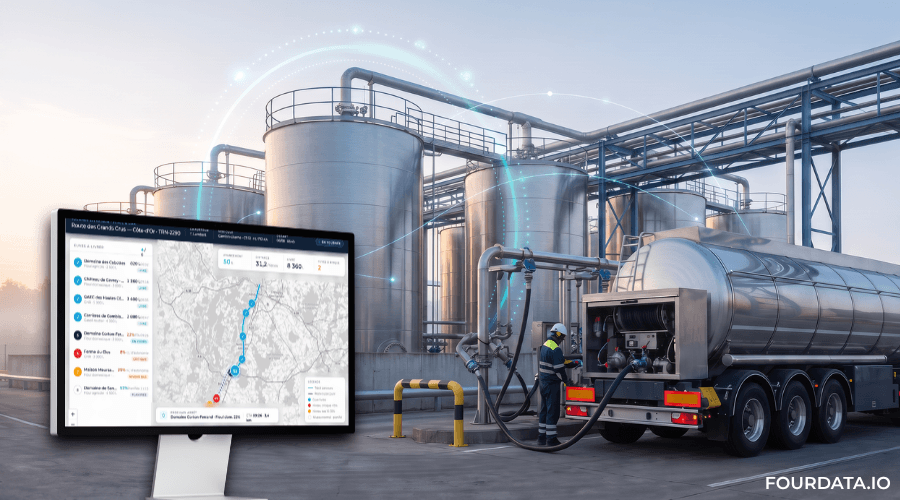
From customer tank to optimized tour – FOUR DATA chain (sensor, connectivity, platform)
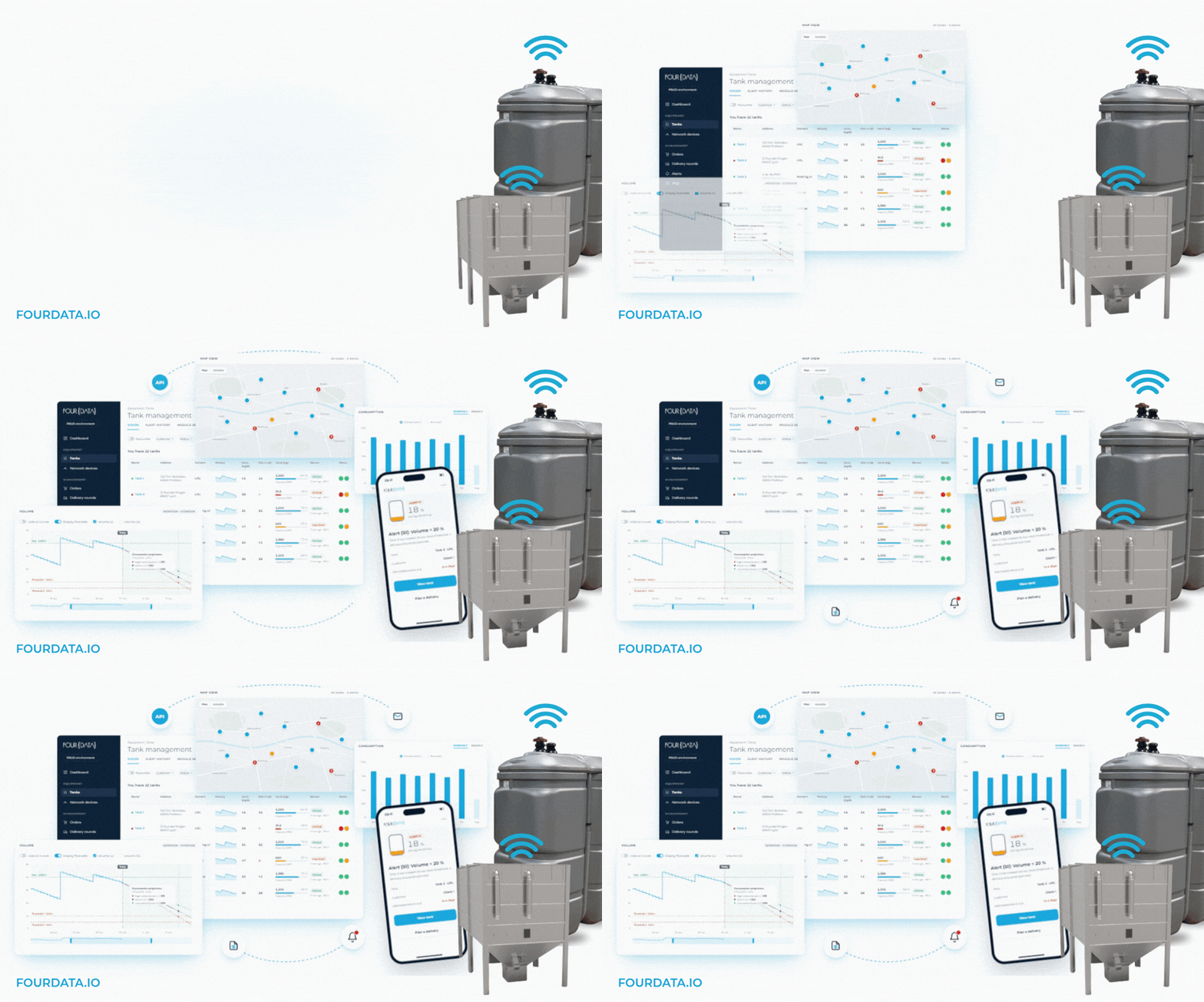
Here’s how it works in practice for the distributors we support. A customer’s tank sends its level several times a day to the Desk supervision platform. The operator sees the need, triggers an alert before the tank is empty, and groups deliveries from the same zone into a single round. The connected fuel gauge replaces visual checks and last-minute customer calls. And delivery rounds are optimized on the basis of real data, not theoretical history.
FOUR DATA designs and manufactures these sensors in-house, in Dijon, and today operates several tens of thousands of sensors deployed in Europe – around 80,000 – at energy distributors such as Antargaz, Vitogaz and Picoty/Brétéché. The chain is complete: sensor, connectivity, business platform, support. It’s not a promise of technological breakthrough. It’s a documented reduction in unnecessary interventions and emergency deliveries, where every kilometer avoided counts.
Benefits at a glance
Delivery controlled by actual consumption rather than blindly – the level sensor replaces visual readings and last-minute customer calls.
The AI that FF3C is talking about starts here. Not in a slogan, in a tank that says its level.
FAQs
What this trade will have to decide
The sector experienced a price shock in 2026, it is undergoing a product transition with biofuel, and it is facing a question that no twenty-year electrification plan can resolve: how to deliver the last liter profitably. The companies that will come out on top are those that know how to manage their business based on real data rather than habits.
Listen to the full interview with Jacques Goisque in the podcast episode above. And if you distribute heating oil, RNG or fuels and want to see what telemetry for heating oil distributors actually does for your routes: let’s talk about your use case with our French team. Our starting point is your tank fleet, not a generic demo.
Article written with the expertise of Quentin Gauthray, Key Account Manager France at FOUR DATA – he helps fuel oil and heating oil distributors optimize their logistics routes and deploy their connected tank fleets. Source: Fédération Française des Combustibles, Carburants et Chauffage (FF3C).
You may also be interested in these articles :