
Industry 4.0 and Logistics: YORK Lubrifiants secures its fluid inventories with FOUR DATA

In a geopolitical context where the supply of hydrocarbons is under constant strain, the meticulous management of industrial stocks has become vital. Gone are the days of rough manual readings and weekend emergencies: here’s a report on the complete digitization of YORK Lubrifiants’ tanks, made possible by FOUR DATA’s expertise.
Supply Chain under pressure: the end of approximation
The spring of 2026 confirms a major trend in global industrial logistics. Between fluctuating crude oil prices, the uncertainties weighing on sea freight – regularly highlighted by reports from the International Energy Agency (IEA) – and the imperatives of decarbonization, petrochemical players no longer have the right to make mistakes.
For lubricant manufacturers and distributors, running out of stock or needlessly moving a half-empty tanker truck is a financial and ecological disaster. The time has come for algorithmic rationalization and real-time telemetry. This is the direction YORK Lubrifiants has taken for its plant and its customers.
YORK Lubricants: high-tech for nearly a century
A tribology institution founded in 1930 in the Var region of France, YORK Lubrifiants (based in La Garde and acquired by the Swiss Motorex group in 2015) formulates and distributes oils, greases and coolants.
Olivier Duperriez, Technical Director for the past 18 years, oversees a laboratory where products are developed and approved specifically for sectors with extreme constraints: public works vehicles, heavy goods vehicles, and grooming machines for ski resorts. The fluids are then shipped throughout Latin Europe and North Africa.
For decades, the management of raw materials (base oils) and finished goods inventories was based on a well-known industry ritual: manual stock-taking.
“Before connectivity, we did things the old-fashioned way. A double-level gauge, and a reading every Friday to estimate the following week’s consumption,” recalls Olivier Duperriez. A time-consuming method that inevitably led to emergency calls to suppliers in the event of unforeseen dry spells.
FOUR DATA: a tailor-made IoT ecosystem “Made in France
To modernize its infrastructure, YORK called on FOUR DATA. Founded in 2016 and now employing around 30 people, this Dijon-based SME stands out in the market for its complete mastery of the value chain: from hardware development to the software platform, including on-site installation.
“We manufacture our sensors in France, with EMS (Electronic Manufacturing Services) partners located in the Rhône Valley and Burgundy-Franche-Comté,” explains Mathias Parthiot, co-founder and Technical Director of FOUR DATA.
To meet YORK’s complex needs, FOUR DATA deployed a tailor-made project, divided into two distinct technological architectures:
Artificial intelligence and zero-packaging logistics
This real-time visibility revolutionizes the sales approach. “Our customers trust us completely. They tell us: ‘I don’t want to break down, I don’t have to worry about ordering, just make sure I always have oil'”, explains YORK’s Technical Manager.
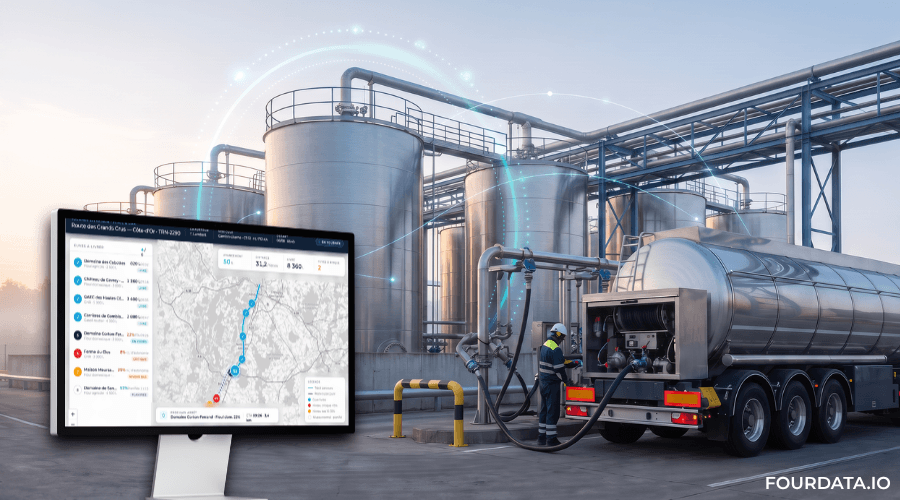
Relying on the Artificial Intelligence integrated by FOUR DATA, YORK can now analyze consumption trends, anticipate disruptions and optimize its routes. If a truck has to deliver to customer A, the system instantly checks whether customer B’s tank (located on the same route) has enough space to justify a grouped delivery.
The ecological impact is direct:
- Reducing empty mileage: drastic optimization of tanker routes.
- Zero-packaging strategy: bulk delivery directly to the connected tanks eliminates the need for metal drums and disposable plastic containers (IBCs), considerably lowering the overall carbon footprint of the distribution cycle.
The next step? Total interconnection via API between FOUR DATA data and YORK ERP (management software), to automatically generate order proposals and invoices. Industry 4.0 at its most efficient.
📌 FAQ : Industrial remote reading and the IoT
You may also be interested in these articles :