
AdBlue tank – use, filling, storage & smart IoT monitoring
Summary
AdBlue plays a central role in reducing emissions from modern diesel engines, as the aqueous urea solution helps to effectively reduce harmful nitrogen oxides in the SCR system. A AdBlue tankwhether in CAR, in the TRUCK or as an external AdBlue tank systemensures that sufficient fluid is available at all times for optimum engine and exhaust performance. It is becoming increasingly important for companies to store AdBlue safely, fill it efficiently and keep an eye on stocks. Intelligent monitoring is becoming increasingly important. This is exactly where Four Data comes in: With smart IoT sensors and a modern platform we create full transparency about your tanks by making your tanks more transparent, safer and more economical.
What is an AdBlue tank?
An AdBlue tank is a specially developed container for the safe storage and supply of AdBlue, an aqueous urea aqueous urea solutionwhich is used in modern diesel vehicles to reduce nitrogen oxides. In a PASSENGER CAR, TRUCK or a stationary AdBlue tank system guarantees the tank guarantees that sufficient AdBlue is available at all times for precise injection and optimum functioning of the SCR system. In addition to being used directly in the vehicle, external AdBlue tanks play a central role in workshops, businesses and fleetswhere large quantities need to be stored and refilled efficiently. The quality and purity of the medium is crucial, as impurities can cause damage to the SCR system. Because with a professional AdBlue tank and the right monitoring solution, safety, logistical efficiency and operating costs can be noticeably improved.
Function in the SCR system
The SCR system (Selective Catalytic Reduction) uses AdBlue to effectively reduce harmful nitrogen oxides (NOx). The fluid is injected into the hot exhaust gas stream in precisely metered quantities, where it decomposes and converts NOx in the catalytic converter into harmless nitrogen (N₂) and water vapor (H₂O) converted. So that these chemical reaction reliably takes placethe AdBlue tank must always have the correct filling quantitytemperature and purity at all times. As a central element of the entire SCR system, it directly influences the performance of the emission reduction and therefore makes a significant contribution to lower exhaust gas values and greater operational safety.
Structure and typical components
- Tank container (HDPE or metal, depending on the application)
- sensors for measuring fill level, temperature and quality
- Piping system between tank and dosing module
- Filler neck for canisters, dispensers or mobile systems
- heatingto avoid crystallization at low temperatures
HDPE is often used because it is corrosion resistant and suitable for urea solution is suitable. Metal is mainly found in large systems.
Differences between vehicle tank and external tank systems
A vehicle tank and an external AdBlue tank system fulfill different tasks and are therefore dimensioned and designed differently:
| Criterion | Vehicle | External system |
|---|---|---|
| volume | approx. 8-30 liters | approx. 200-10,000+ liters |
| Utilization | Supply of a vehicle in driving mode | Storage and supply of several vehicles / fleets |
| Mobility | Permanently installed in the vehicle | Available as a stationary or mobile solution |
Refill AdBlue correctly
When does AdBlue need to be topped up?
The optimal time to refilling AdBlue depends on the vehicle type. Cars usually display a warning symbol on the display and show a Remaining range in kilometers on. In the case of trucks, the warning is issued earlier as consumption is higher. Typical indications:
- Yellow or red warning message
- Message “AdBlue level low”
- Noticeable reduction in the remaining range
Step-by-step instructions for filling
Correct refueling ensures to ensure that the vehicle works reliably and the SCR system remains protected. This is how you proceed:
Checklist
- Vehicle safely and switch off the switch off the engine.
- Tank cap of the AdBlue tank.
- Canister, dispenser or mobile pump attach.
- Fill in AdBlue slowly and check the check the filling quantity.
- Close the lid and make sure it is clean.
Common mistakes when refilling and how to avoid them
Typical errors occurwhen AdBlue is stored incorrectly or not properly filled is filled. The most common points:
- Wrong opening caught (confusion with the diesel tank)
- Overfilling due to filling too quickly
- Contamination due to unsuitable canisters
- Filling at extreme temperatures
What happens if you continue driving without AdBlue?
If the AdBlue tank runs low, the vehicle automatically reduces engine power. Modern systems even block the engine start when the tank is completely empty to prevent damage. A Timely refilling is therefore important to avoid breakdowns and repairs.
Costs, consumption & sources of supply
AdBlue consumption by vehicle type
The AdBlue consumption depends heavily on the vehicle and the motor load. With PASSENGER CAR is consumption on average 1-2 % of the diesel consumptionwhile TRUCKS due to larger engines and higher loads up to 6 % are required.
Comparison table :
| Vehicle type | Consumption Ø |
|---|---|
| PASSENGER CAR | 1-2 % of diesel consumption |
| TRUCKS | up to 6 % |
Key figures : 1,000 km ≈ 1 liter AdBlue (passenger car Ø).
Prices and cost factors
The prices vary depending on the source of supply and container size. Decisive are above all Quality, price per literstorage and transportation.
Price range (standard values) :
- Petrol station : higher price per liter
- Canister (10-20 L) : cheaperideal for cars
- IBC containers: best economy for companies and large consumption volumes
| Container | Ø Liter Price |
|---|---|
| Petrol station | highest |
| Canister | medium |
| IBC (stationary AdBlue tank systems) | most favorable |
Where can I buy or fill up with AdBlue?
AdBlue is available at numerous service stationsin garages, in online shops and in large containers such as IBCS available. For companies and fleets are particularly suitable for stationary AdBlue tank systems or mobile solutions.
Typical sources of supply :
- Petrol stations & AdBlue pumps
- garages and vehicle service companies
- Online stores (canisters, 20-1,000 L)
- IBC containers for large filling volumes
AdBlue tanks for workshops, businesses and fleets
Who needs a stationary or mobile tank system?
Stationary and mobile AdBlue refueling systems are used wherever several vehicles need to be refueled reliably and quickly. Typical users are
- Logistics and transportation company
- Agricultural businesses with tractors and commercial vehicles
- Garages and car service companies
- Companies with mixed fleets (cars, trucks, machines)
Overview of tank types (stationary, mobile, IBC, large volume)
Depending on the application and required filling quantity AdBlue tanks are available in various designs and sizes.
Mini-Overview :
- Stationary tanks : large capacity, ideal for farms
- Mobile tanks : flexible usable, perfect for construction sites or outdoor use
- IBC container : cost-efficient, suitable for 1,000 L
- Large volume systemsseveral thousand liters, ideal for fleets
Important criteria in the selection process: capacity, mobility, dispensing options and integration into the existing system.
Choice of materials, safety & standards
Tanks must meet certain requirements so that AdBlue can be stored safely:
- Materials : HDPE, metal or double-walled systems
- Protection : UV-resistant, suitable for urea solution
- Standards : ISO 22241, specifications for purity and storage
Accessories: pumps, hoses, nozzles, sensors
For safe refueling and efficient use, suitable accessories are essential :
- electric or manual pumps
- Hoses in various lengths
- Dispensing nozzles for cars or trucks
- Sensors for temperature, fill level and quality
Depending on the area of application, these components offer a clean, safe and standard-compliant supply.
Storage & transportation of AdBlue
Requirements for temperature, UV protection & purity
AdBlue must be stored under controlled conditions so that the aqueous urea solution remains stable and no impurities arise. To ensure that AdBlue retains its high quality, it should always be stored under optimum conditions. Temperatures between -10 °C and +30 °C ensure that the aqueous urea solution remains stable. Direct sunlight, intense heat or dirt particles should be avoided at all costs, as they can impair the quality and cause damage to the SCR system.
IBC containers & suitable storage systems
IBC container are among the most practical solutions for companies that want to store or transport large quantities of AdBlue. Advantages :
- Robust capacity (1,000 liters)
- Cost-efficient price per liter
- Suitable for workshops, fleets and stationary systems
Thanks to their stability and easy handling, they can be easily integrated into existing tank and pump systems.
Maintenance, cleaning and service life of the tank
Regular maintenance increases the service life of every AdBlue tank system and reduces the risk of system faults.
Checklist – good maintenance :
- Thoroughly flush the tank every 12-24 months
- Check seals and connections for cracks
- Check sensors and lines for deposits
- Only use approved cleaning agents
These measures help to reduce costs and ensure the high quality of the liquid in the long term.
IoT & level monitoring – Our solutions at Four Data
Advantages of a networked AdBlue tank
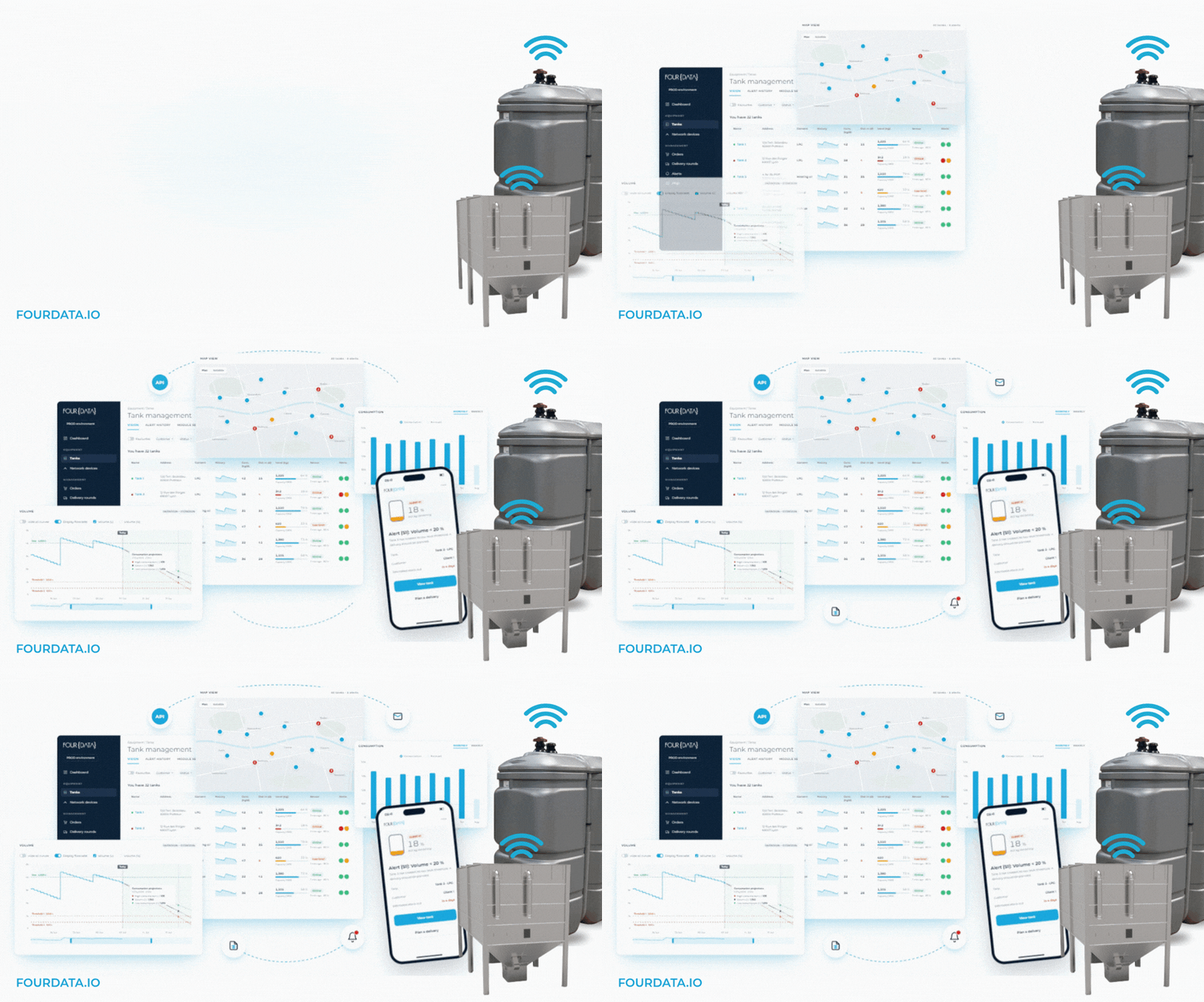
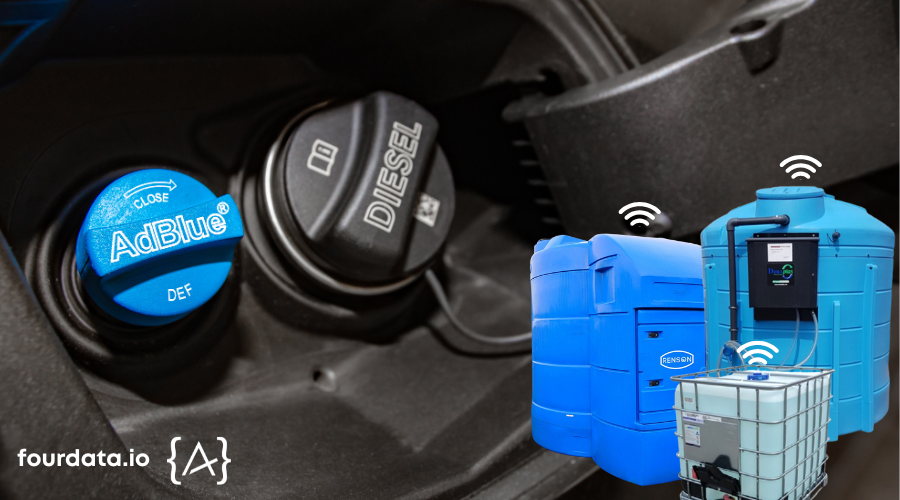
A digitally networked AdBlue tank enables precise monitoring of the filling quantityautomatic warning messages when the level is low and better deployment planning your vehicles. This allows routes to be optimized, bottlenecks to be avoided and service calls to be made. much better control.
Sensors, level measurement & alarm messages
For reliable monitoring, we rely on high-precision IoT sensors that work stably even with different tank sizes and media.
Sensors & functions :
- Ultrasonic or pressure sensors for precise measured values
- Temperature and quality monitoring
- Automatic warning messages via e-mail, app or dashboard
- Support for stationary and mobile AdBlue tank systems
Our IoT management platform (dashboard, API, multi-sensor)
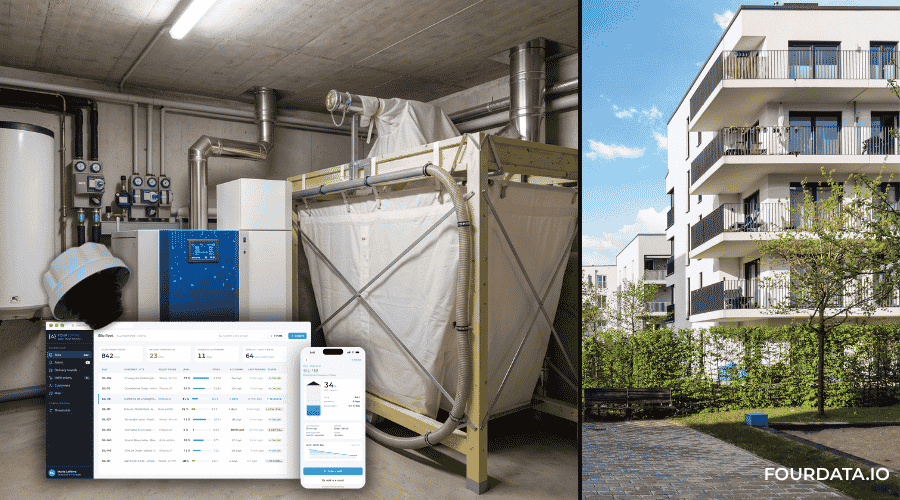
Our platform visualizes all levels in real time and enables centralized access to multiple tanks: from IBCs to large systems. The data can be easily integrated into existing systems via API interfaces. Thanks to multi-sensor support, even complex installations can be easily managed and monitored.
Areas of application: Industry, agriculture, logistics, energy
- Industry Reliable supply of machinery
- Agricultural : Control of AdBlue tanks for tractors and farm equipment
- Logistics Fleet management & automatic refill planning
- Energy & Communities: Monitoring of stationary AdBlue tanks and filling stations
Buying the right AdBlue tank
Purchase criteria: Volume, material, mobility, equipment
When selecting an AdBlue tank system several factors should be considered :
- Volume Depending on consumption and size of the fleet
- Material HDPE for reliable corrosion protection, metal for robust locations
- Mobility stationary or mobile depending on application
- Equipment integrated pump, sensors, nozzle, heater
These criteria determine how efficiently and safely the system in daily operation can be used on a daily basis.
Compatibility with cars, trucks, tractors & industrial vehicles
| Vehicle type | Recommended tank type |
|---|---|
| PASSENGER CAR | Small mobile tank (50-200 L) |
| HGV | Stationary tanks 500-2,000 L |
| Tractors / Agriculture | mobile IBC containers or yard equipment |
| Industry / Fleets | Large volume tanks (2,000-10,000+ L) |
The right choice guarantees safe refueling and optimized processes.
Tips for buying online & choosing a suitable model
When buying online, companies should pay attention to quality, standards and equipment. The following are helpful:
- certified products according to ISO 22241
- Suitable pump for cars or trucks
- robust materials & reliable frost protection
- Check ratings and technical descriptions
- Compare scope of delivery & accessories
Checklist – 5 points to check before buying : Volume, material, equipment, standards, guarantee.
FAQ about AdBlue tanks
Efficient AdBlue use thanks to smart monitoring
The correct storage, use and monitoring of an AdBlue tank reduces costs, protects the SCR system and ensures the reliable operation of your vehicles or systems. With our IoT platform, you can keep an eye on your fill level at all times.
Contact us, we will be happy to advise you gladly about your AdBlue tank system!
You may also be interested in these articles :