Industrial Equipment Rental: Integrating the Sensor at the Time of Purchase to Sell Follow-Up Services
Summary
Reading time: 11 min · Updated on July 16, 2026 · Prepared with the expertise of Capucine Dubreuille, marketing director at FOUR DATA
Contents
- Why Leasing Companies and OEMs Will Be Equipping Their Fleets in 2026
- What specific information a sensor integrated into the park transmits
- Retrofit or factory-installed sensor: What changes?
- ALOREM x FOUR DATA: The mobile tank comes ready to use
- Fueling as a Service: An Example with Numbers
- White label: the landlord retains the customer relationship
- How FOUR DATA Contributes to a Project for a Rental Company or OEM
- FAQ
A “connected” industrial device is a device (tank, storage tank, generator, construction trailer, IBC) equipped with a sensor that transmits data on level, consumption, or position to a monitoring platform. For a rental company or an OEM, this sensor—which is already integrated into the equipment fleet—transforms rented equipment into a billable service: refueling, alerts, and consumption monitoring.
Friday, 4:00 p.m. At a construction site 90 km from the depot, a generator runs out of fuel. The customer calls, furious. You rush a driver to the site, pay overtime, and by the following Monday, the construction supervisor is already comparing your competitors’ rates. This scenario costs equipment rental companies a lot of money, and it keeps happening as long as the fuel level in the tank isn’t visible from the depot.
A sensor installed at the entrance to the parking lot eliminates this blind spot and opens up a revenue stream that many property owners fail to take advantage of: the tracking service.
Key Figure
There are currently approximately 80,000 FOUR DATA sensors in use in Europe, on fleets consisting of a combination of stationary tanks, mobile tanks, and construction site equipment.
Why Leasing Companies and OEMs Will Be Equipping Their Fleets in 2026
In the rental market, the focus is shifting away from the daily rate for equipment. Two rental companies offering the same generator at the same price can only differentiate themselves in terms of service: which of the two can tell its customer how much GNR is left in the tank, where the equipment is located, and when the next delivery is scheduled?
The same reasoning applies to OEMs, but with an added advantage. A tank manufacturer that supplies equipment with built-in telemetry is selling a product that stands out from the competition and maintains a connection with the equipment even after the sale: usage data, maintenance, and retrofitting.
The business model is changing as a result. A rented device generates rental income—plain and simple. A device with an internet connection generates rental income, plus a subscription fee for monitoring, plus a margin on refueling or maintenance triggered by the data. For a fleet of 500 machines, a few euros in monthly service fees per machine can quickly outweigh the final discount negotiated on the purchase price of the machines.
A third factor makes it necessary to make a decision now. French telecom providersplanto shut down2G and 3G networks by2028–2029 (according to ARCEP’s timeline). Leased equipment remains in use for 5 to 10 years: by opting for a sustainable connectivity solution (NB-IoT, LTE-M, LoRaWAN) now, you can avoid having to retrofit an entire fleet during its lifespan.
Benefits at a glance
Rent + a tracking subscription + a fuel surcharge instead of just rent — the same fleet, but converted into recurring service revenue.
What exactly a sensor integrated into the park transmits
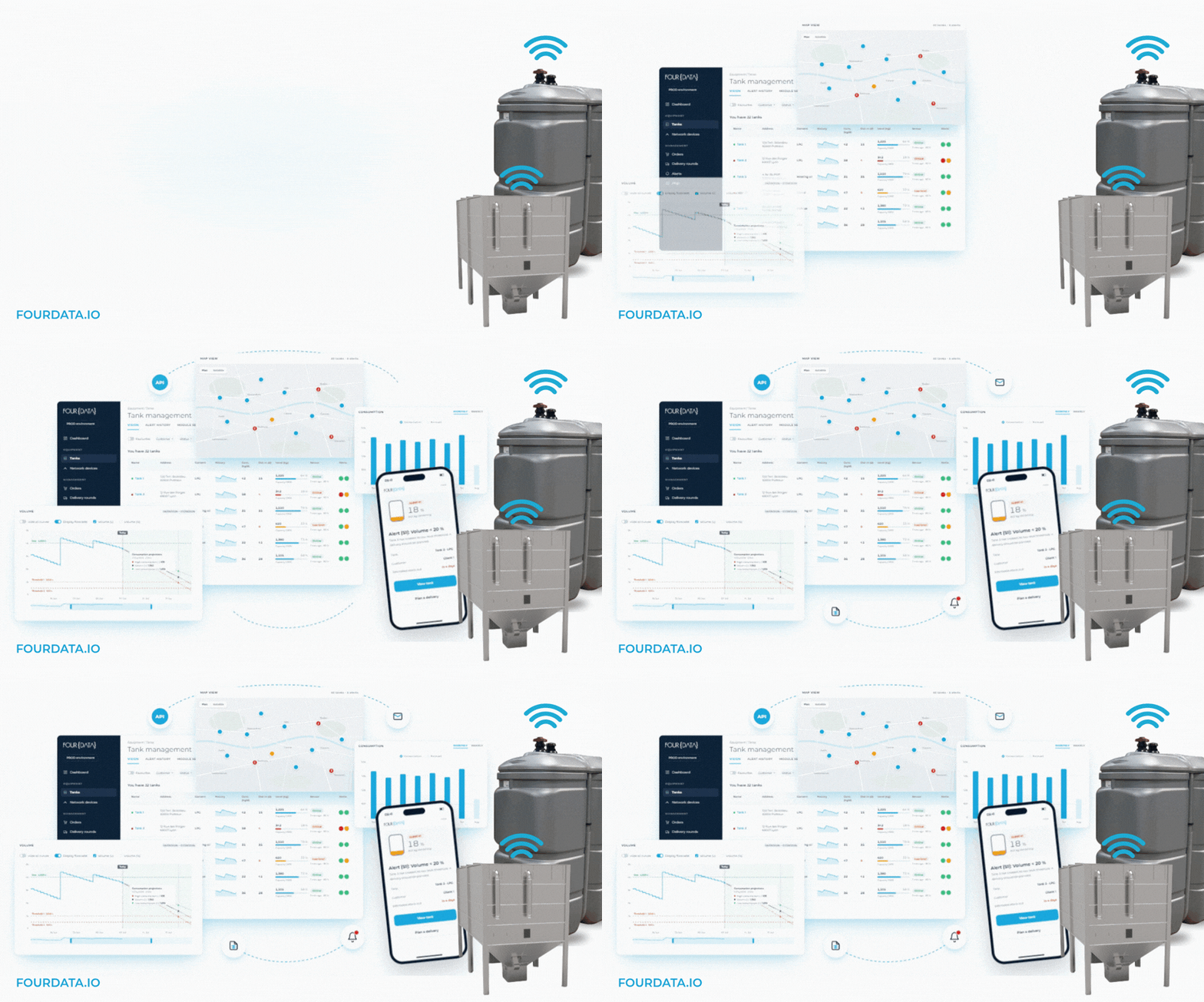
FOUR DATA develops multifunctional sensors that measure both the level and the GPS position of the same device, transmitting the data to the Desk and Sens platforms at a configurable frequency. For a fleet manager, these four types of data bring about a change in daily operations.
FOUR DATA’s value chain, from the sensor in the field to the operational decision
Level and Consumption
The sensor monitors the contents of the tank or reservoir: remaining liters, consumption rate, and estimated remaining capacity. The lessor knows that a construction site consumes 2,000 liters of GNR per week and schedules deliveries based on the actual levels in the GNR tanks at the construction site, not on estimates.
Location and Status of the Equipment
Geolocation provides answers to two questions that concern park managers: Where is the equipment located, and is it being used? Equipment that sits idle at a completed construction site does not generate rental income. Thanks to the combination of elevation and GPS data, even an unreported movement or unusual usage can be detected.
Geo-fencing takes it one step further: you define an authorized area, and the platform sends a notification as soon as a tank leaves that area. When a standard GPS module uses too much battery power or receives a weak signal, the TOWERCELL LOCATOR option locates the sensor via triangulation using three network antennas, without GPS: lower power consumption, better coverage in areas without signal.
Note
At a remote construction site or an unguarded storage yard, geofencing provides immediate protection against fuel theft: as soon as the vehicle leaves the area, an alarm is triggered even before the fuel is stolen.
Warnings Regarding Adjustable Threshold Values
You set the thresholds, after which the platform alerts your teams: low level, prolonged inactivity, out of range. The base camps are a good example of the opposite of fuel: there, the alert concerns filling the wastewater tanks to prevent overflows and avoid last-minute pickups.
Integration with existing tools
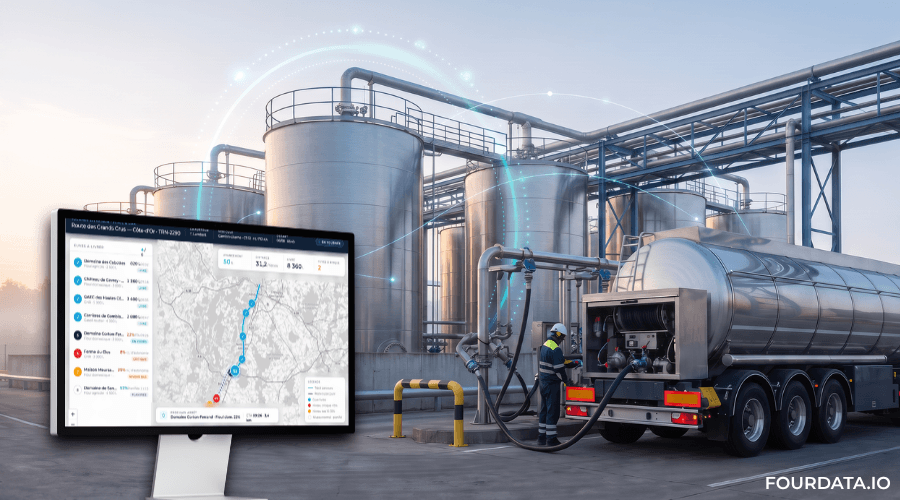
The data is linked to your business software—ERP, CMMS, CRM, or a rental management platform—via secure APIs. Route planning and invoicing for refueling are then based on the same data source as the monitoring.
Retrofit or factory-installed sensor: What changes?
Retrofitting remains a relevant way to enhance the value of the existing fleet, and FOUR DATA implements this for its clients in the energy sector.However, integrating it at an earlier stage changes the nature of the offering: monitoring is no longer a technical option, but rather an integral part of the product being leased or sold.
ALOREM x FOUR DATA: The mobile tank comes ready to use
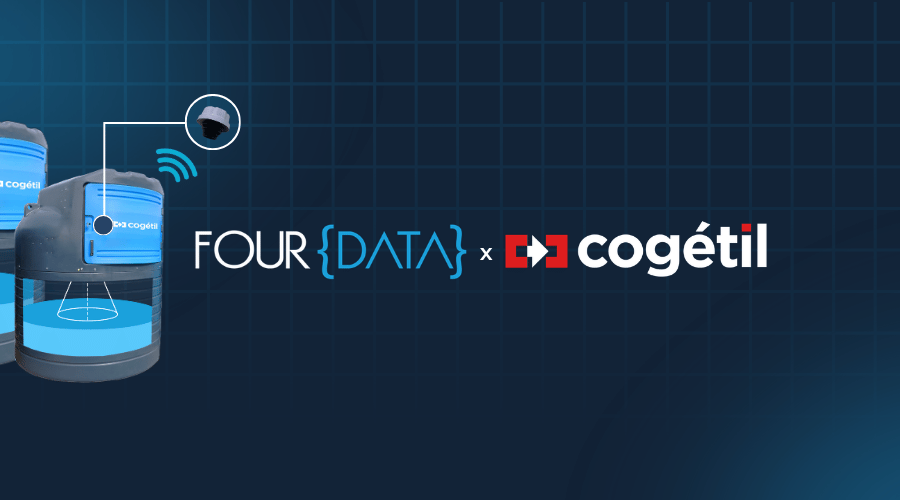
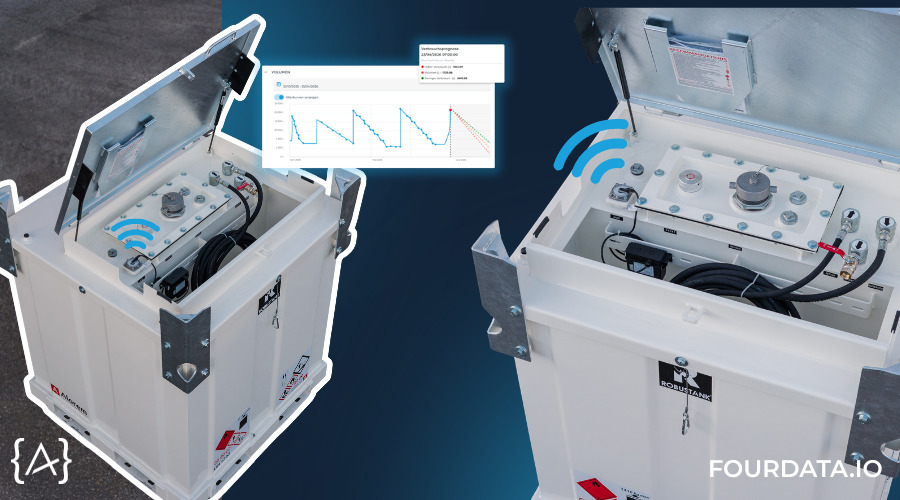
The best example of native integration is the partnership between ALOREM and FOUR DATA. ALOREM manufactures and distributes mobile, connected, and secure tanks for fuel, GNR, AdBlue, and water, designed for the construction, agriculture, transportation, and rental sectors. Every ALOREM tank now comes equipped with a factory-installed FOUR DATA level sensor, which is ready for use immediately upon commissioning.
Professionals who receive their ALOREM tank don’t need to install anything, configure anything, or order any separate sensors. The tank is connected from day one: fuel level monitoring, precise geolocation, and direct access to the FOUR DATA platform to view consumption, alerts, and history.
The commercial offer is designed to remove the final barrier to adoption. ALOREM covers the cost of the first year of the subscription at no additional cost to the customer. No charges are incurred for an unactivated meter: the subscription does not take effectuntil the meter is actually activated, so there is no need to pay for equipment that remains unused in inventory.
“An ALOREM tank equipped with a FOUR DATA level sensor guarantees smart, safe, and automated monitoring from day one.”
— Wesley Pélissier, Sales Manager, ALOREM SAS
This model illustrates the benefits a manufacturer gains by integrating FOUR DATA at an early stage. ALOREM no longer sells just a tank: it sells a smart tank that complies with ADR standards, is connected via multi-network IoT technology, and is linked to FOUR DATA’s SaaS platform. The end customer gains greater autonomy and safety, while the manufacturer stands out from the competition and maintains a connection with each device even after the sale.
Fueling as a Service: An Example with Numbers
Let’s take a look at the example described in the 2026 FOUR DATA catalog. A rental company provides a generator and an attached fuel tank at a construction site for a period of two months. Consumption: 2,000 liters of GNR per week, or 16,000 liters over the entire period, which amounts to approximately 18,000 € in fuel at a price of 1,128 € per 1,000 liters.
The lessor offers refueling as a service and charges an additional 0.50 € per liter delivered to cover logistics costs. Each delivery of 2,000 liters therefore generates approximately 1,000 € in logistics margin. The FOUR DATA sensor costs a total of 400 €, including equipment, connectivity, and access to the platform.
The calculation boils down to one sentence: the sensor pays for itself with the very first refueling. All subsequent refills are pure profit, and the rental company arranges them at the right time, since it can monitor the fuel level remotely. As a result, the end customer never runs out of fuel while pouring concrete.
Sample Calculation — Standard Case from the FOUR DATA 2026 Catalog
White label: the landlord retains the customer relationship
In conversations with landlords and OEMs, one question keeps coming up: “If my end customer views their data on a third-party platform, who owns the relationship?” FOUR DATA’s answer is Sens.
Sens, FOUR DATA’s white-label platform: your logo, your colors, your domain name. End customers view the status and history of their devices through an interface that bears your brand. You sell a digital service under your own name; FOUR DATA remains behind the scenes. When it comes to operations, your teams manage the entire device fleet via Desk, the operator platform.
This approach also applies to manufacturers: an OEM can supply its tanks with built-in telemetry and a customer interface under its own brand name, without having to develop a software product line in-house.
How FOUR DATA Contributes to a Project for a Rental Company or OEM
FOUR DATA manages the entire chain in-house: the design of the level sensors developed by FOUR DATA, connectivity (NB-IoT, LTE-M, LoRaWAN, Sigfox), the Desk and Sens platforms, API integration, and implementation support. There are approximately 80,000 sensors in use across Europe, at energy suppliers such as Antargaz Energies, Vitogaz, and Dyneff.
In an OEM project, this vertical integration plays a role in three specific areas:
- The choice of sensor —ultrasonic, pressure, radar, or ratiometric—depends on the tank and the liquid, with ATEX-certified versions available for flammable products.
- The network coverage test —which is performed before installation to avoid unpleasant surprises in areas without coverage.
- Maintenance — 2-year warranty on the sensors; replacements will be handled by FOUR DATA, a subcontractor, or your own teams.
FOUR DATA’s ratiometric meter, which is designed in-house and assembled in France, can be installed without modifications on tanks already equipped with a Rochester, Cotrako, or Rotarex float, which simplifies the retrofitting of an existing fleet of tanks. The installation has been deliberately kept simple, following the Plug & Play principle, with a service life of 5 to 10 years, depending on the frequency with which data is read.
Expert advice
Before every installation, we conduct an on-site test to check network coverage. A sensor that performs poorly in an area with no coverage costs more than a project that is properly sized from the start—this is the first step for a rental fleet where the equipment changes locations weekly.
FAQ
Switch from rented equipment to the maintenance service
A connected device fleet is built up step by step: a few pilot devices, a network coverage test, API integration, and then the full rollout. The teams at FOUR DATA will conduct an audit of your device fleet, identify which devices are a priority, and provide a cost estimate for an architecture comprising sensors, connectivity, and a platform tailored to your specific needs.
This article was written with the expertise of Capucine Dubreuille, marketing director at FOUR DATA.
You may also be interested in these articles :