
Stored materials inventory: DREAL compliance | FOUR DATA

Summary
⏱ 8 min read · Published on 11/09/2026 · Updated 11/09/2026, 09h02
Written with the expertise of François Clément, Sales Director at FOUR DATA, who supports energy distributors in bringing their depots into regulatory compliance.
Field reports have been piling up for several months: the DREAL (the French regional environmental authority) is visiting fuel distributors’ depots and focusing on one specific document, the stored materials inventory. On several sites, inspectors have asked for connected tank gauging systems to make this tracking reliable.
This requirement does not come out of nowhere. It stems directly from the order of 24 September 2020, adopted after the Lubrizol fire. Here is what the text says, who is concerned, and how telemetry turns this regulatory constraint into an operational tool.
Key figure
The French government’s post-Lubrizol action plan calls for doubling the number of inspections of classified facilities. This intensification of controls is what fuel distributors are now seeing at their depots.
What does the order of 24 September 2020 require?
The order of 24 September 2020, adopted after the Lubrizol fire, requires French classified facilities (ICPE) subject to authorisation to keep a stored materials inventory: updated at least weekly, daily for hazardous materials, reconciled through an annual physical inventory and accessible at all times, including during an incident.
In detail, the text amends the ministerial order of 4 October 2010 on the prevention of accidental risks at classified facilities. Its reinforced provisions have applied since 1 January 2022. Operators must now:
- Detail, zone by zone, all hazardous materials stored, linked to their hazard properties and grouped by families of hazard statements within the meaning of the Seveso directive. A substance that is both flammable and toxic to the environment must appear under both properties.
- Keep this inventory up to date at least weekly, and daily for hazardous materials, where appropriate using IT tools.
- Reconcile it at least once a year through a physical inventory, possibly on a rolling basis.
- Accompany it with a general plan of the storage areas and reference it in the internal operations plan (POI) where one exists.
- Make it accessible at all times, including during an incident, an accident or a loss of utilities, to the prefect, the classified facilities inspectorate, the fire and rescue services and the health authorities. A summary version, readable by the public, must be available for rapid release in the event of an accident.
Note
The obligation also covers non-hazardous combustible materials, even those that fall under no ICPE classification heading.
Lubrizol, 26 September 2019: why the regulations were tightened
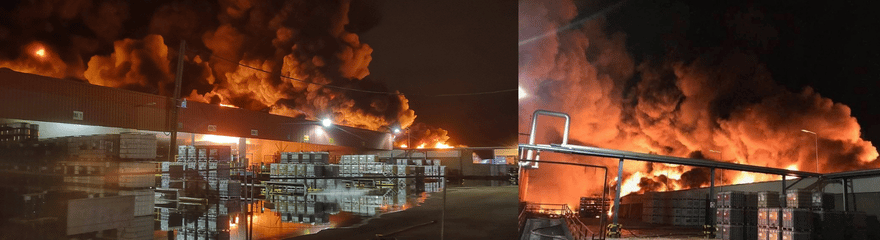
During the night of 25 to 26 September 2019, a fire broke out at the Lubrizol and Normandie Logistique sites in Rouen. Nearly 10,000 tonnes of products went up in smoke. Through the first hours of the crisis, one question remained without a clear answer: what exactly was in storage?
The government’s post-incident review pointed to that gap. It is impossible to protect the public and first responders effectively without knowing the nature and quantity of the materials present on a site. The action plan presented in February 2020 drew the consequences: stronger requirements on stock knowledge, and a doubling of the number of inspections of classified facilities.
The orders of 24 September 2020, published almost exactly one year after the fire, turned those commitments into law. It is this second component, the increase in inspections, that fuel distributors are now experiencing at their depots.
Fuel depots: are you concerned?
Depots storing heating oil, off-road diesel (GNR), diesel or biofuels fall under the ICPE headings applicable to flammable liquids. Depending on the volumes stored, the facility is subject to declaration, registration or authorisation, and it is this regime that determines the exact scope of your obligations.
The most complete requirements target authorisation-level sites, but keeping a stock inventory also appears, in practice, in many individual prefectoral orders. IoT monitoring of oil and gas sites is designed precisely for this framework.
In concrete terms, during a visit the inspector seeks to verify four things:
It is on the second and third points, updating and accuracy, that gaps are most frequent.
Attention
A manual reading taken on Monday says nothing about the real level on Thursday, after two deliveries and one unloading. And a spreadsheet kept at the office will be of no use to emergency services at 3 a.m.
Hence the request, made by the DREAL at several depots, to fit tanks with connected gauging systems.
Telemetry: automating the stock inventory instead of enduring it
Let’s be precise on one point: the order does not mandate telemetry as such. It mandates a result, an accurate inventory, updated daily for hazardous materials, and available in all circumstances.
In theory, manual readings can get you there. But on a depot with ten or twenty tanks and daily movements, manual gauging becomes a job in its own right, and a source of errors the inspectorate will eventually flag.
Connected measurement solves the problem by design. Each tank is fitted with a sensor suited to its configuration: pressure sensing for buried or above-ground fuel tanks, with the NOVA PRESSION sensor designed and manufactured by FOUR DATA, compatible with heating oil, off-road diesel and B100. Readings travel over the NB-IoT or LTE-M cellular networks to a remote tank monitoring platform that centralises levels across the whole depot, or across several sites. For depots that need local control, a PLC completes the setup with high-level alerts directly on site.
FOUR DATA measurement chain — optional on-site PLC for high-level alerts
Regulatory tracking then changes in nature. The daily update is no longer a task, it is native: levels are timestamped, historised, exportable. On inspection day, you present a continuous measurement history rather than a logbook of readings. During an incident, the stock inventory is accessible remotely, which matches exactly the accessibility requirement of the text, “including in the event of an accident”.
“Bringing a depot into compliance starts with an assessment of the tank fleet: gauging technologies in place, products stored, ICPE regime, ATEX constraints. Our teams carry out this audit and deliver a quote in under 48 hours, with sensors suited to each container and a platform that keeps the stock inventory updated daily.”
— François Clément, Sales Director, FOUR DATA
What equipped distributors already do
FOUR DATA has deployed close to 80,000 sensors across Europe, an increasing share of them on distribution depots. Fuel distributors such as Gruchy Combustibles and Alliance Énergies track their storage through the FOUR DATA platform: levels available continuously, configurable alerts on critical thresholds, history on hand for operations and for the authorities alike.
The benefit goes beyond compliance. The same data serves to optimise depot replenishment, secure product availability and document stock movements.
Advantage at a glance
Tracking that works for you instead of a constraint to endure — the same data serves regulatory compliance and operational optimisation.
FAQ
Anticipate rather than endure
Inspections are intensifying and the trend will not reverse: doubling the number of inspections was a public commitment by the French State. Achieving compliance under the pressure of a formal notice always costs more, in delays as in peace of mind, than planned equipment.
An audit of your tank fleet tells you precisely where you stand, and what would need to be equipped.
You may also be interested in these articles :