
Fuel Oil Tank Monitoring: Full Services Case | FOUR DATA

Summary
10 min read · Customer story · Published on 08/10/2026
Article written with the expertise of Dirk Plaat, Key Account Manager Benelux at FOUR DATA, who supports Belgian and Dutch distributors in monitoring their tanks.
In this article
- Full Services: a family business with several trades
- More than 200 tanks monitored remotely since 2020
- How a connected gauge works on a fuel oil tank
- A platform migration without replacing a single sensor
- Train the teams first, inform customers second
- What a connected tank gauge changes in practice
- An acknowledged cost, a measured rollout
- A shrinking market, and service as the differentiator
- Next step: pellet silos
- What a distributor can take from this story
- FAQ
A connected tank gauge lets a fuel oil distributor know the level of every customer tank without driving there. It is used to deliver at the right time, avoid run-outs and group deliveries so trucks drive fewer kilometres. Full Services, a Belgian distributor, has used remote tank monitoring since 2020 and now tracks more than 200 equipped tanks.
Its sales manager and director, Thomas Fadel, explains what this changes day to day, from the move off the Full Up platform to FOUR DATA, to his view of a market that is shrinking.
Key figure
More than 200 equipped tanks are now monitored remotely by Full Services, a Belgian distributor that has used tank telemetry since 2020.
Full Services: a family business with several trades
Full Services is a Belgian family-owned company. Its original business is the distribution of petroleum products and fuels. It later added refrigerated road transport, delivering food products for various customers across Belgium, and a smaller activity renting refrigerated trailers to the events sector.
Thomas Fadel is sales manager and director. He describes a company built on two things: closeness to its customers and a high level of service.
For a fuel oil distributor, service starts with something simple. Customers want their tank to be full when they need it, without having to think about it.
More than 200 tanks monitored remotely since 2020
Full Services has used tank telemetry for six years. The first installations date back to 2020, at the time on the Full Up platform, which is now part of FOUR DATA. The monitored fleet now exceeds 200 equipped tanks.
That number matters. At this scale, a distributor can no longer run deliveries on gut feeling or phone calls. Every equipped tank is a customer whose level is known remotely, which changes how a delivery day is prepared.
Drivers no longer work through a list of customers to visit out of habit. They leave with a list of tanks that actually need filling.
How a connected gauge works on a fuel oil tank
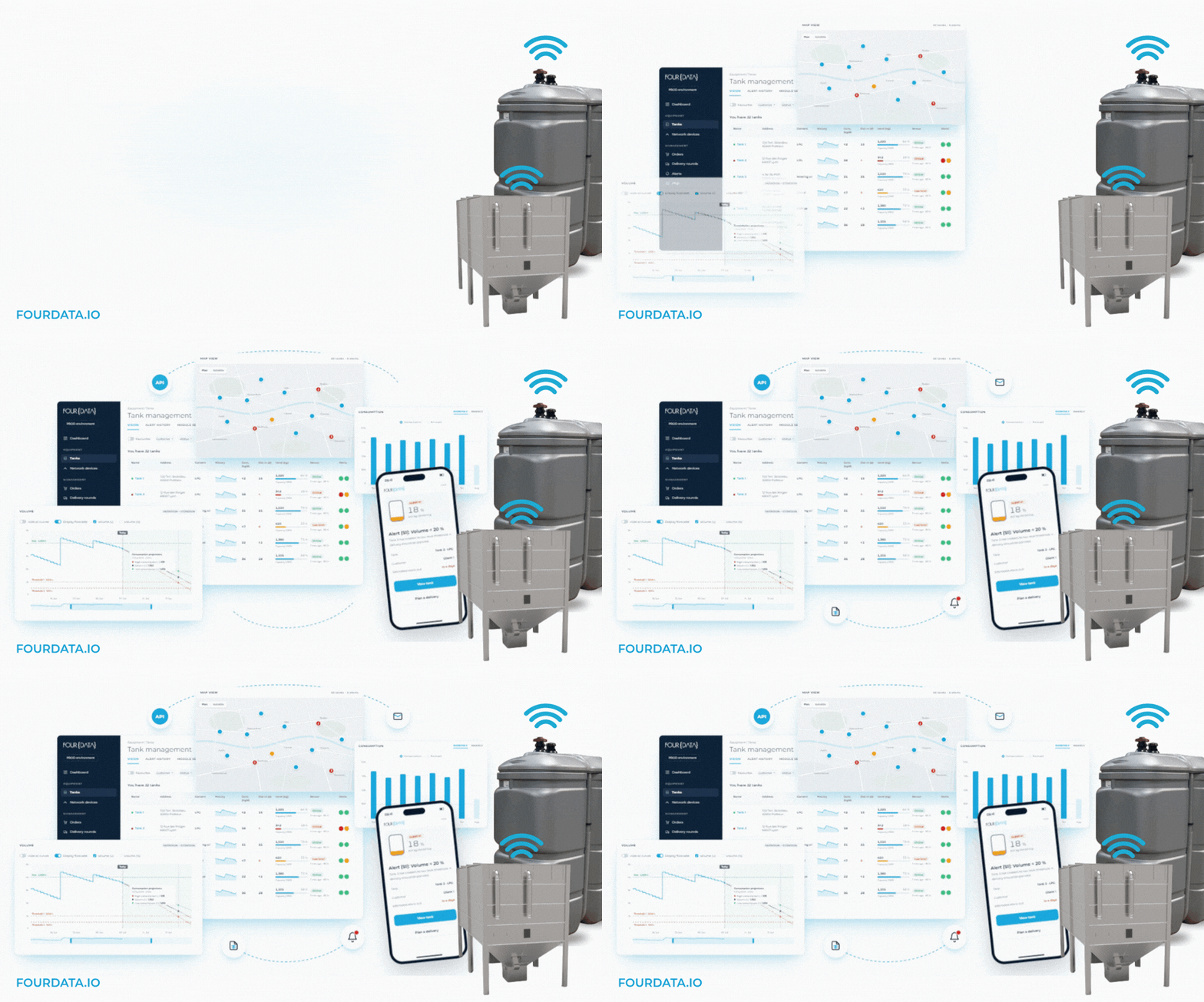
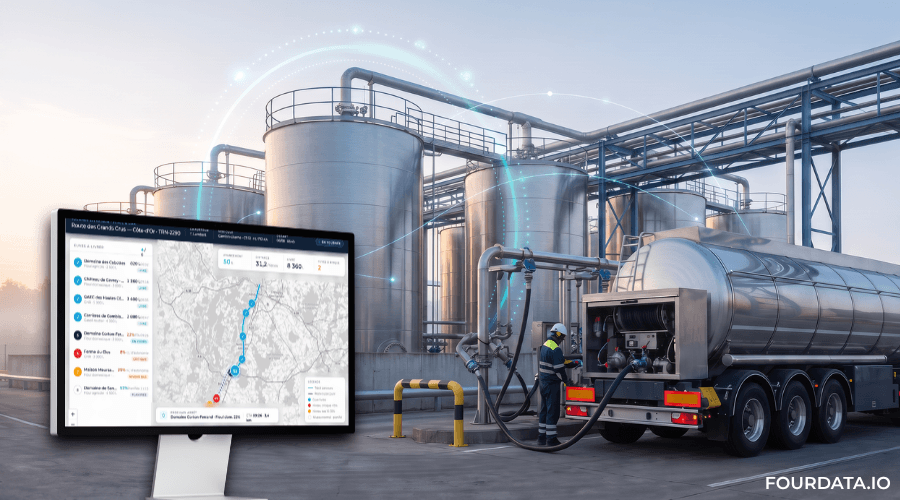
The principle is simple. A sensor is fitted to the existing tank, with no need to replace it. It measures the fuel level, by ultrasound in most fuel oil tank configurations, then sends the reading over a low-power network such as NB-IoT or LTE-M to an online platform. The distributor checks levels on a dashboard, sets alert thresholds and plans routes.
From the customer tank to the delivery round: how a connected gauge reports fuel levels
Note
Before any rollout, a network coverage test checks that the sensor will transmit properly from the tank’s location, including in a cellar or a technical room.
A platform migration without replacing a single sensor
Attention
Moving from one platform to another is a delicate moment for any distributor. The change affects internal teams, installation technicians and above all end customers, who have no reason to go through a technical transition.
Thomas Fadel sums up the experience by saying the transition went “very smoothly”. The decisive point is technical. The existing installations were kept, with no sensor replaced. Full Services therefore did not have to visit any customer for this reason, which protects both the hardware investment and the commercial relationship.
The FOUR DATA and Full Services teams also agreed on a planned migration together, for customers and internal teams alike. The distributor did not have a schedule imposed on it. It helped build it.
“Very smoothly”
Thomas Fadel, sales manager and director of Full Services, on the transition from Full Up to FOUR DATA
Train the teams first, inform customers second
The order in which things were done explains much of the success. Full Services was trained first, then told its customers about the change.
Training was delivered by Théophile Huberlant of the FOUR DATA team to three audiences:
- Full Services’ installation technician
- the teams who run the dashboard for customers
- the customers themselves
Each group received the information it needed, at a level of detail suited to its role.
Full Services then sent a newsletter to its entire customer base announcing the migration. The result, according to Thomas Fadel: a few customers asked questions, but very few about how the tool works. A team trained beforehand answers questions itself, without escalating every case to the supplier.
He adds something that matters in a supplier relationship. His teams never felt lost or left behind, because they found familiar faces on the other side. For a distributor, the end customer’s trust rests on its own company. So it has to be able to trust its technology supplier.
The Full Up to FOUR DATA migration in figures. Source: interview with Thomas Fadel, Full Services
What a connected tank gauge changes in practice
What customers want, Thomas Fadel says, is a full tank and the service that goes with it. Full Services first used the platform in a fairly basic way. That simplicity is a strength: the core functions, level and alerts, must be solid before they get sophisticated.
Three benefits come out of his account.
Avoiding run-outs
Monitoring fuel levels at customer sites helps avoid outright run-outs. Deliveries are triggered by field data, not by a worried customer’s phone call.
For a household heating with oil or a business running machinery on it, running dry is the worst case. It is also the one the distributor least wants to handle as an emergency.
Better-paced delivery rounds
Knowing the real level of each tank, the distributor groups deliveries and cuts the kilometres driven by truck. Thomas Fadel stresses the environmental value of this, on top of the economic value.
Fewer kilometres means less fuel burned to deliver fuel, and fewer driving hours for drivers.
Planning sensor maintenance
Among the extras on the platform, he mentions the display of each device’s battery level. Across more than 200 sensors, that information is valuable.
The distributor can plan a replacement before a device stops reporting, and combine it with another visit to the same customer. It avoids finding out that a sensor has gone silent just as the tank is nearly empty.
An acknowledged cost, a measured rollout
This interview does not dodge the question of price. Full Services offers the gauge to more and more customers, but Thomas Fadel acknowledges that the solution has a cost. The rollout is therefore done with common sense: it depends on the level of service to reach and the efficiency wanted for each customer.
Expert advice
This is a pragmatic approach, and one we see among many distributors. The gauge is not meant to equip every tank overnight. It is deployed first where the service and logistics gain is clearest:
- high-consumption customers
- hard-to-reach sites
- tanks far from usual routes
It then extends at the pace the distributor chooses.
A shrinking market, and service as the differentiator
Full Services is open about its reading of the market. The Belgian government tends to favour new energies, which is consistent with the energy transition. The company has been preparing for about 10 years by diversifying:
- transport
- rentals
- and now acquisitions of other companies within the group
The idea is not to rely on a single core business on the day demand for fossil fuels drops sharply.
Thomas Fadel is nonetheless convinced that fossil fuels cannot be replaced quickly. Many machines and trades still depend on them: farmers in the middle of harvest, road planers. The trade may become more of a niche, but there will always be a need for companies that offer closeness and a high level of service.
His view of the future is a lucid one. The pie will shrink, so will the number of players, and the sector will consolidate, perhaps geographically, perhaps by trade. He sees know-how consolidating too, always moving toward more services.
In that context, his priority is clear: keep the contact with customers and the level of service, even when growing through acquisitions. This is where field data becomes a differentiator for a local distributor, and not only a logistics tool. When players become fewer, the one who knows before the customer does that a tank is running low stays a step ahead.
Next step: pellet silos
Thomas Fadel has one wish: that the system evolves toward monitoring pellets in silos. He says he is eager to test this new solution.
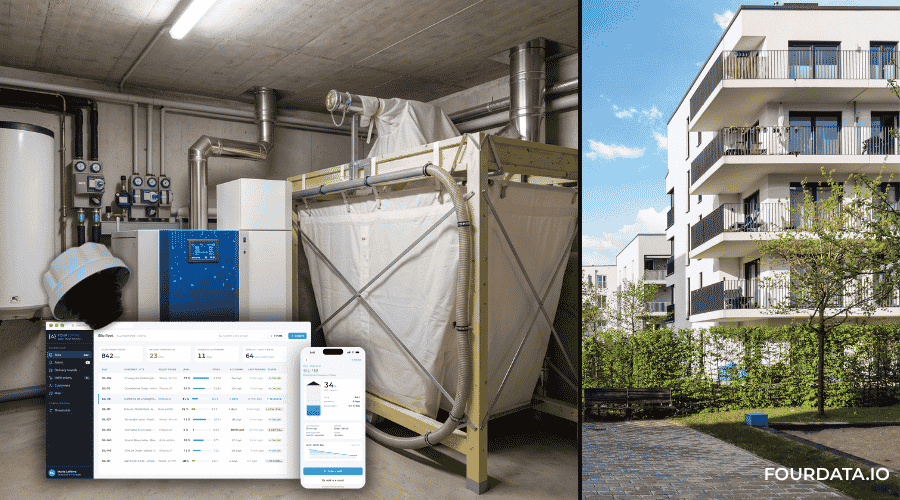
FOUR DATA does develop level measurement solutions for pellet silos, including a radar sensor suited to this type of storage. For a fuel distributor, this opens a second product family to supervise from the same platform, with the same dashboards and the same alerts as for fuel oil. A distributor who already delivers heating oil and pellets can follow all its customers in one place.
What a distributor can take from this story
A platform migration can be done without replacing installed sensors, which protects the investment and limits visits to customers.
Training internal teams before informing customers sharply reduces questions and friction.
Each sensor’s battery level, visible on the platform, lets you plan replacements instead of suffering them.
The gain from a connected gauge is measured in run-outs avoided and kilometres saved.
The rollout follows the service level targeted for each customer.
FAQ
Let’s talk about your tank monitoring project
You distribute heating oil, gas or pellets and want to see what remote tank monitoring could change in your delivery rounds? Talk to Dirk Plaat, our Benelux expert, and let’s discuss your project.
You may also be interested in these articles :