Oil tank inspection Belgium: 2026 rules by region
Summary
Yes, oil tank inspection is mandatory in Belgium, but not for everyone and not at the same frequency. It all depends on your region, your tank’s capacity and whether it sits aboveground or underground.
A 2,000-litre tank in a Walloon cellar does not follow the same rules as an 8,000-litre underground tank in Brussels. Below you will find a region-by-region summary table, the detail of each obligation, the price ranges and a downloadable checklist to review your own situation in ten points.
At a glance: oil tank inspection by region
| Region | Tanks concerned | Periodic inspection frequency | Who inspects | Document issued | Risk |
|---|---|---|---|---|---|
| Wallonia | Heating oil storage of 3,000 to 24,999 L (class 3, declaration). Environmental permit above 25,000 L | 3 years (single wall) or 10 years (double protection) | Technician or expert approved by the Walloon Region | Certificate of conformity + green, orange or red plate | Red plate: refilling prohibited |
| Brussels | Any underground tank connected to a boiler. Aboveground storage from 3,000 L | Compliant underground: 3 years. Compliant aboveground: 5 years. Installation not brought into compliance: every year | Storage installation expert approved by Brussels Environment | Inspection report + green, orange or red plate | Fine, ban on use, even a prison sentence |
| Flanders | Keuring before commissioning. Periodic inspection mainly for underground tanks | Underground tank: periodic inspection. Aboveground tank: inspection at installation | Erkend technicus | Conformiteitsattest + green, orange or red dop | Delivery refused by the supplier |
In Wallonia the starting rule is simple: a storage installation of 3,000 to 24,999 litres is a class 3 facility, which must be the subject of a declaration and must meet the conditions of the Walloon Government decree of 17 July 2003, including periodic inspection by an approved technician. For the full framework, see our page on heating oil tank regulations in Belgium.
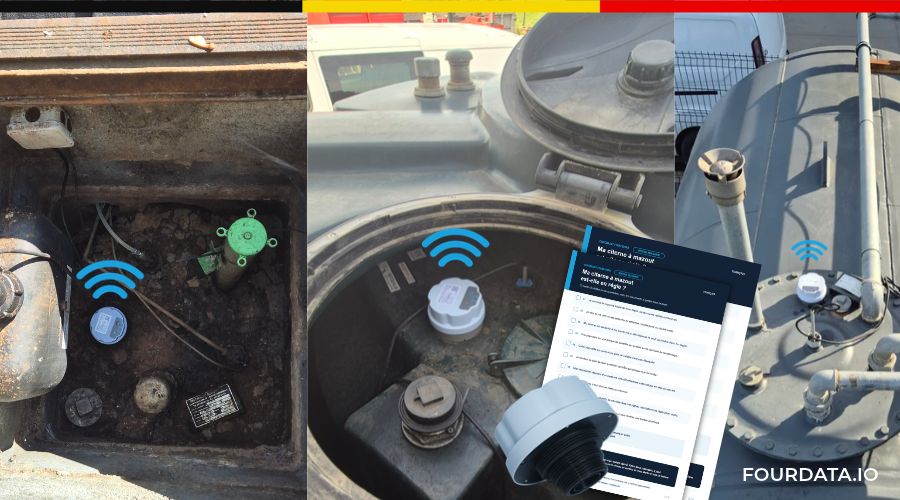
Download the free checklist: is my oil tank compliant? Ten points to check in five minutes, with the documents to keep to hand.
PDF, one page, to print or keep on your phone.
Oil tank inspection in Wallonia
Which tanks are concerned?
The trigger threshold is 3,000 litres, calculated across the whole storage installation rather than tank by tank. Two connected 1,500-litre tanks therefore count as a 3,000-litre installation. Below that threshold, no periodic inspection is imposed on a private owner. Above 25,000 litres you move into the environmental permit regime, which is rare for a private household.
The declaration is made to your municipal administration. It is mandatory as soon as you store heating oil in one tank, or in several connected tanks, with a capacity of 3,000 litres or more.
Aboveground or underground tank: what changes
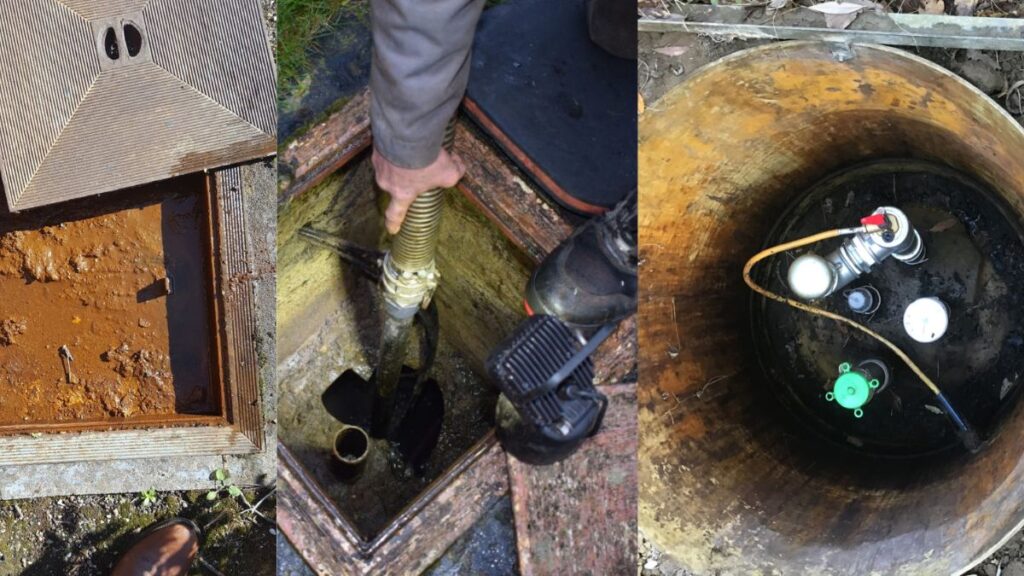
An aboveground tank, sitting in a cellar, a garage or a garden, is inspected visually first: the technician can see the walls. An underground tank cannot be seen, so the inspection relies on indirect measurements, mainly an oil tank tightness test by ultrasound or by vacuum.
That is what explains the gap in frequency. A single-wall underground tank is inspected more often than a double-wall tank fitted with a leak detector in the interstitial space, because the second one signals a perforation itself before it turns into pollution.
Aboveground or underground: whether the walls can be seen is what decides the inspection method.
What does the technician check?
The inspection covers the whole storage installation, not just the tank:
After the inspection: green, orange or red plate
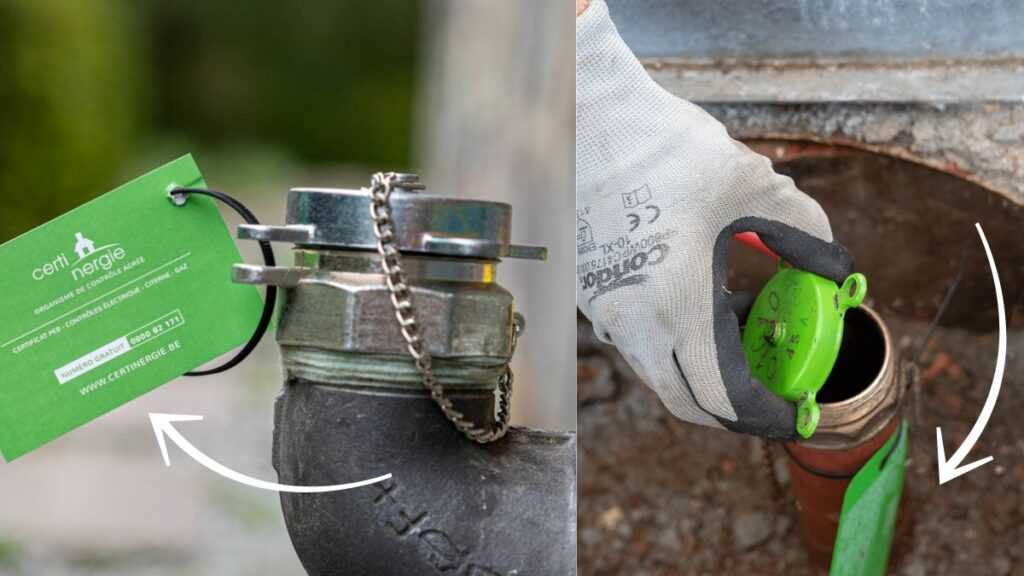
To be allowed to refill your oil tank in Wallonia, it must carry a green plate, sealed onto the fill pipe. That is the document your supplier looks at before delivering.
A tank on a red plate can be repaired and then inspected again, or decommissioned.
The detailed procedures are set out in the official brochure of the Public Service of Wallonia, Heating oil tanks in Wallonia, and on its Managing your oil tank information sheet. Both are published in French.
Oil tank inspection in Brussels
The class 3 declaration
In Brussels your tank falls under heading 88.3 of classified installations. Class 3, and therefore subject to a declaration to the municipality, covers storage with a total capacity of 10,000 litres or less where the tanks are underground, and storage of 3,000 to 10,000 litres in all other cases. From more than 10,000 up to 50,000 litres you move into class 2. Above 50,000 litres it becomes class 1B, handled by Brussels Environment.
In practice: an underground tank is concerned whatever its size, while an aboveground tank is concerned from 3,000 litres.
Periodic inspection and tightness inspection
Brussels deadlines are more detailed than Walloon ones, and they depend on how well equipped the installation is.
For an existing underground tank fitted with an overfill prevention system, a vent pipe discharging into open air and a double wall with permanent leak detection, the inspection is due every 3 years. For an aboveground tank equipped in the same way, the deadline is 5 years. Underground tanks of 10,000 litres or less that were not fitted with a double wall and permanent leak detection after 27 August 2023 must undergo annual periodic inspections.
The inspection is carried out by an approved storage installation expert. They give you an inspection report and send a copy to the competent authority, either the municipality or Brussels Environment, within 30 days. If the tank is single wall, the expert inspects the tightness of the complete installation.
What follows depends on the result. An orange plate, issued for a non-compliance without soil contamination, gives you a maximum of six months to carry out repairs. Once that deadline passes without repair, the installation must be permanently decommissioned. A red plate signals soil contamination: the tank must be emptied, degassed and cleaned immediately, a soil condition survey must be carried out, and the tank repaired or replaced within six months at most.
Official references: the Brussels Environment pages on underground oil tanks and aboveground oil tanks, together with the decree of 1 February 2018 on storage of flammable liquids used as fuel. These official pages are published in French.
Selling a property with an oil tank
A buyer, their notary and their bank almost always ask for the tank logbook: dated and signed inspection reports, repair certificates, tank drawings. Brussels Environment specifically requires this logbook to be kept on site and produced in case of an inspection. A tank with no history pushes the price down or delays the deed.
What about Flanders?
In Flanders the framework is VLAREM II and the vocabulary changes: people talk about keuring stookolietank. The obligation mainly targets underground tanks, which are inspected periodically, while an aboveground tank heating a private home is mostly covered by the inspection at installation. The capacity thresholds and exact frequencies depend on your installation: check your own case on the official Vlaanderen website before booking an intervention.
How much does an oil tank inspection cost?
Oil tank inspection prices are not regulated: every provider sets its own. The ranges below are the rates published by Belgian providers in November 2026, for Wallonia and Brussels, VAT included.
Surveyed in November 2026: Certigreen price list and energiebewustontwerpen price survey. A basic tightness test is usually included in the inspection price.
Three factors then weigh on the invoice:
Always ask for a quote stating whether the certificate and the plate are included, and compare providers: nothing caps these prices. Expect a supplement for an urgent call-out, a long trip or fitting an overfill prevention device.
Is a fill whistle mandatory?
The whistle is not an automatic safety device. It is a tube that whistles during delivery and goes quiet when the maximum level is reached: it warns the driver, but it cuts nothing off.
What the regulations require is an automatic overfill prevention system. In Brussels the tank must be fitted with an overfill prevention system that automatically cuts off the supply as soon as the tank is filled to 98 % maximum. In Wallonia an overfill prevention device is also required on the installations concerned.
In other words: a whistle on its own is no longer enough on a recent installation. If your tank only has a whistle, the technician will flag it at the inspection.
The tightness test: when and how?
The tightness test comes into play in three situations: at commissioning, during a periodic inspection when the walls are not visible, and after a repair affecting tightness.
Two methods dominate. The ultrasonic test measures wall thickness and picks up corrosion without emptying the tank. The vacuum test creates a partial vacuum and watches the pressure recover: any loss signals a leak. On an aboveground tank whose walls are all accessible and which is properly bunded, a visual examination can be enough.
One point that often gets underestimated: in Brussels, if the bund does not respect the required clearances, the tank is treated as not accessible and the tightness of the installation has to be inspected. Insufficient clearance around the tank can therefore trigger a chargeable test on its own.
Non-compliant tank: what are the options?
Three routes, in increasing order of cost.
Adding an overfill prevention system, a compliant vent pipe, a sealed bund, replacing an external transparent hose. This is where most orange plates end up.
Welding, relining the wall with an internal membrane, reworking the connections. It must be carried out by an approved expert, followed by a fresh inspection, and the certificates must be sent to the competent authority.
When repair is not possible, the tank is emptied, degassed and cleaned, then removed or filled with sand or another inert material, with prior agreement from the authority. The waste generated is hazardous waste and must go to an authorised operator, with full traceability.
Between two inspections: day-to-day tank monitoring
A regulatory inspection photographs the state of your installation at a single moment. Three, five or ten years can pass between two visits. That is a long time to spot consumption drifting or an abnormal drop in level.
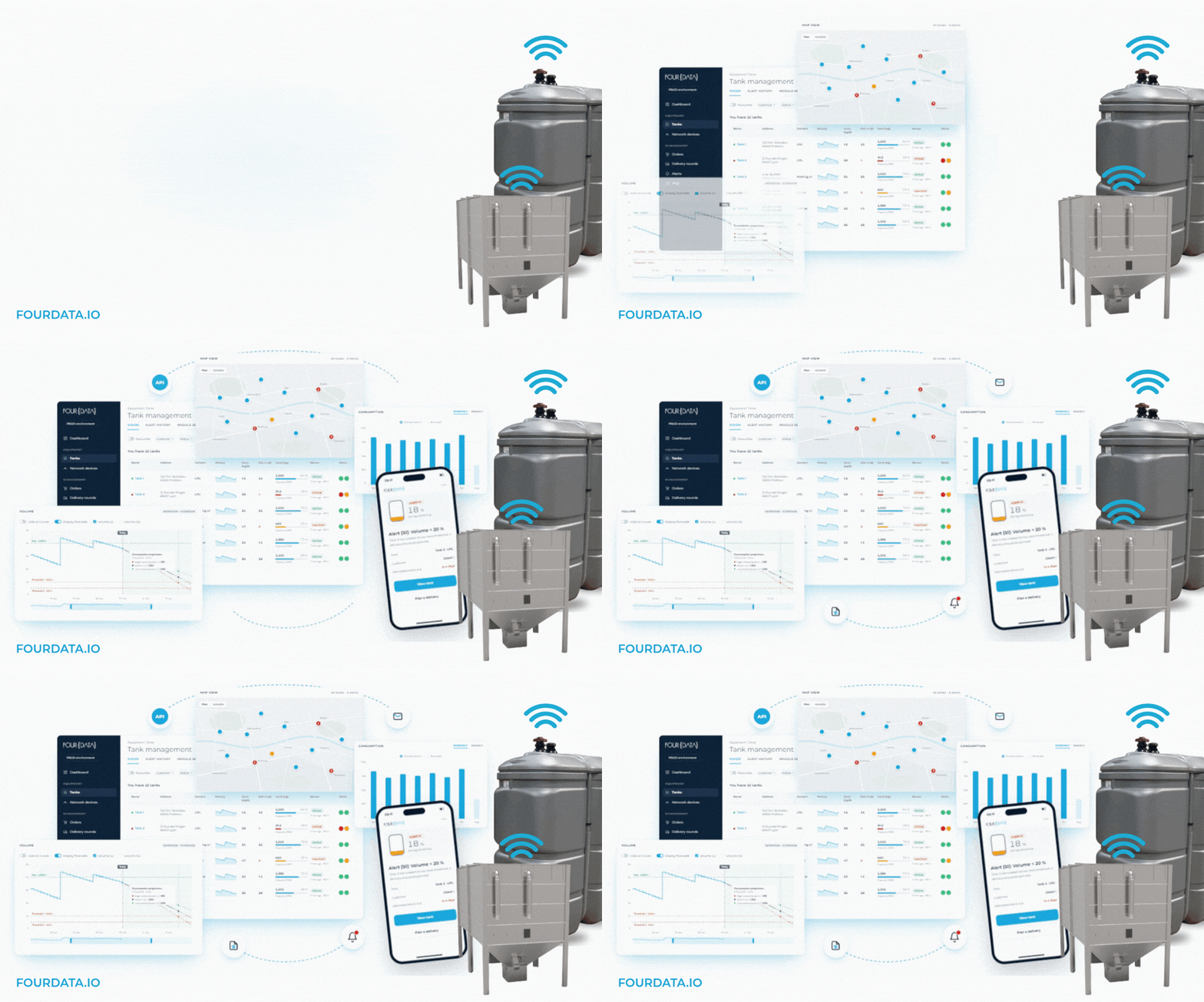
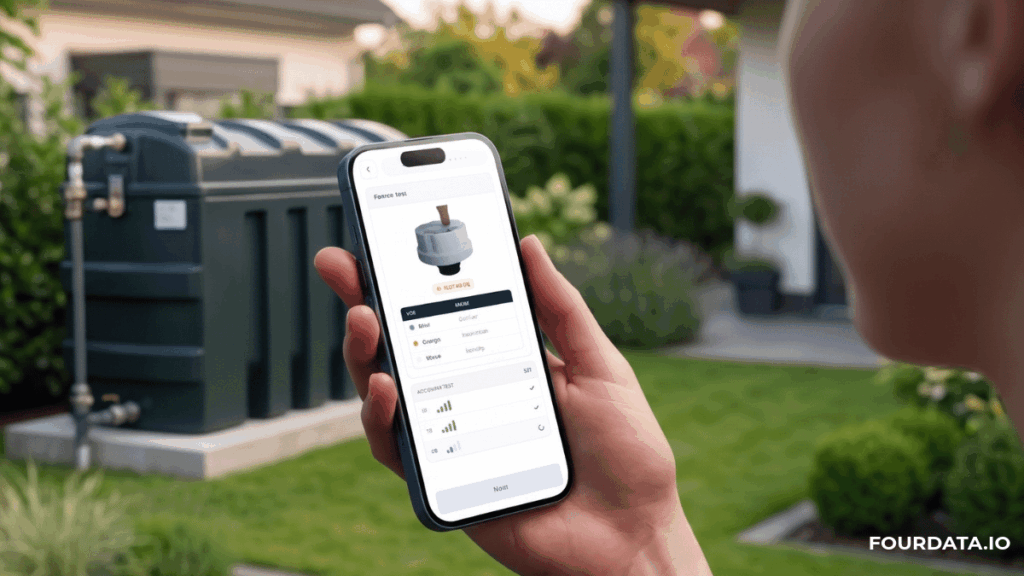
This is where a connected oil tank gauge comes in. A sensor measures the level continuously, sends the data to a smartphone and makes three concrete things possible:
The difference with a mechanical gauge comes down to history and alerts: a conventional gauge shows a level if you go and read it, a connected gauge warns you. We cover this in our comparison of conventional and connected gauges, and the installation is explained in our guide to fitting a connected gauge on a tank.
Four Data designs and manufactures these sensors in France and has around 80,000 of them deployed across Europe, a significant share with Belgian heating oil distributors. A connected sensor is obviously no substitute for the regulatory inspection: it fills the gap between two inspections.
Get an alert when your tank level drops abnormally.
Discover the Four Data connected oil tank gauge, or talk it through with our Benelux team.
FAQ
Is an inspection of my oil tank mandatory?
It depends on your region and on your installation. In Wallonia the obligation starts at 3,000 litres for a heating oil installation. In Brussels every underground tank is concerned, and aboveground tanks from 3,000 litres. In Flanders the underground tank is the main target.
How often does an oil tank have to be inspected?
In Brussels, every 3 years for a compliant underground tank and every 5 years for a compliant aboveground tank. In Wallonia it depends on the wall type: 3 years for a single wall, 10 years for double protection. An installation not brought into compliance can be inspected every year.
How much does an oil tank inspection cost?
Reckon on €185 to €225 incl. VAT for an aboveground tank under 10,000 litres and €250 to €350 incl. VAT for an underground tank, based on rates published by Belgian providers in November 2026. The price is not regulated: ask for several quotes and check that the certificate and the plate are included.
Who can inspect an oil tank in Wallonia?
A technician or expert approved by the Walloon Region, depending on whether it is a periodic inspection or a commissioning. Your usual heating engineer is not automatically approved for this. Check the approval before booking.
Does an oil tank have to be declared in Brussels?
Yes in most cases. Underground storage up to 10,000 litres, or aboveground storage of 3,000 to 10,000 litres, falls under class 3 and is declared to the municipality. Above 10,000 litres an environmental permit is required.
Is a fill whistle mandatory?
A whistle on its own is not enough. The regulations require an automatic overfill prevention system that cuts off the supply when the tank reaches its maximum level, set at 98 % in Brussels. The whistle remains a useful audible cue for the driver, with no automatic safety value.
What happens if a tank is not compliant?
First a refused delivery: without a valid plate, your supplier will not fill the tank. Then administrative sanctions, ranging from a fine to a ban on use. In case of soil contamination, remediation costs are yours and can far exceed the cost of an inspection.
In summary
Oil tank inspection turns on three variables: your region, the capacity of the installation and the type of tank. Check the date on your plate first, then whether an overfill prevention system is fitted, then the state of your logbook. Those three points settle most situations.
Download the free checklist: is my oil tank compliant?
You may also be interested in these articles :