
Optimising fuel delivery routes with the FOUR DATA connected sensor
Summary
- What the 5 August 2026 EIA report says
- Why fuel, diesel and off-road diesel distributors are on the front line
- Before: a field run by phone
- The three data points to cross
- With FOUR DATA: field data becomes a routing criterion
- What measurement changes, with the numbers
- After: from reactive to prepared dispatching
- FAQ
- Prioritise your fuel tanks by their real days-of-autonomy
7 min read · Updated 6 August 2026
In this article
- What the 5 August 2026 EIA report says
- Why fuel, diesel and off-road diesel distributors are on the front line
- Before: a field run by phone
- The three data points to cross
- With FOUR DATA: field data becomes a routing criterion
- What measurement changes, with the numbers
- After: from reactive to prepared dispatching
- FAQ
When refined-product availability tightens, the distributor’s question is no longer “how much do I deliver this week” but “which tank do I fill first“. A dispatcher running two hundred customer tanks on the phone and on manual readings does not have that answer at hand.
They send half-empty trucks to comfortable sites while a critical customer slips below the threshold without warning. Level data, reported at a regular cadence from every tank, shifts that trade-off: it ranks deliveries by real days-of-autonomy rather than by routing habit. That is the subject of this article — turning a field measurement into a logistics priority order.
How do you prioritise fuel deliveries when stocks tighten? You cross three data points per tank: the measured real level, recent average consumption and the workable delivery lead time. Remaining days-of-autonomy follow from these. Tanks whose autonomy drops below the resupply lead time move to the front of the route, ahead of sites that are still comfortable.
Key figure
On 31 July 2026, U.S. distillate stocks fell to 107.2 million barrels, about 12% below the five-year average, against a backdrop of record diesel exports (1.884 Mbpd) — the sign of a tight Atlantic basin.
What the 5 August 2026 EIA report says
On 5 August 2026, the U.S. Energy Information Administration (EIA) published its weekly report for the week ending 31 July. Commercial crude oil stocks rose by 2.5 million barrels, to 407.0 million, against analysts who expected a draw.
Refined products tell the opposite story: distillate stocks fell by 3.5 million barrels, to 107.2 million, about 12% below the five-year average. The drop comes from record diesel exports, 1.884 million barrels per day, the highest level in EIA records since 2010.
Source: U.S. EIA, Weekly Petroleum Status Report — distillate stock changes (weeks ending 10, 17, 24 and 31 July 2026).
Note
Middle distillates group road diesel, heating oil, off-road diesel (GNR) and kerosene — all from the same refining cut. When their stocks fall, these products, the core target of distributors equipped by FOUR DATA, become harder to secure.
These figures describe the U.S. market, not French tanks. They remain a useful barometer: diesel and heating oil trade on a connected Atlantic basin, and record U.S. exports pull on the same supply European distributors draw from. For a distributor, the operational message is simple: better to deliver right than to deliver out of habit.
Why fuel, diesel and off-road diesel distributors are on the front line
A fuel distributor does not feel market tension as a mere price increase. They feel it in their logistics. Every week supply tightens, a single misplaced delivery costs twice: in margin on the product, and in kilometres on routes that could have waited.
Four product families share the same refining cut and the same exposure:
- off-road diesel (GNR) on construction sites;
- diesel for captive fleets;
- heating oil for households;
- heavy fuel oil for industrial sites.
An operations manager who keeps visibility on each site’s days-of-autonomy also keeps control of their trade-offs: defer a non-urgent delivery, combine two nearby sites, avoid a round trip for a tank that will hold for another ten days. Without field data, those decisions are made blind.
Before: a field run by phone
In many organisations, customer stocks are still tracked by calls, control rounds and manual readings. The method holds while the fleet stays small. Past a few hundred tanks, cisterns, silos or IBCs, it breaks.
The symptoms are always the same:
- trucks leaving half-empty;
- emergency deliveries billed at a premium;
- data scattered across a spreadsheet, a notebook and the driver’s memory;
- customer service that learns of the run-out at the same time as the client.
On sensitive products such as heating oil, off-road diesel, LPG or AdBlue, this uncertainty becomes an operational, commercial and sometimes regulatory problem.
Attention
An emergency delivery costs, in our model, around €120: a driver on the road runs close to €4 per kilometre, truck and fuel included. Every badly ordered route is paid for twice.
The three data points to cross
Sound route arbitration does not rest on level alone. Three data points combine:
- real level — the measured tank content, in volume or fill percentage;
- consumption — the rate at which the site empties its tank, computed over recent weeks;
- lead time — the time a truck needs to reach the site, a geographic as much as a logistical constraint.
From these three follows days-of-autonomy: the number of days before the tank hits its critical threshold. It is this autonomy, not the raw level, that should order the route. A tank at 40% that empties fast and sits two hours away is more urgent than a tank at 25% that is stable and close.
With FOUR DATA: field data becomes a routing criterion
FOUR DATA designs and manufactures its sensors, develops its platforms and deploys the whole chain in-house, within an IoT tank-telemetry ecosystem. This full chain, from the sensor to field support, sets the company apart from hardware-only or software-only players.
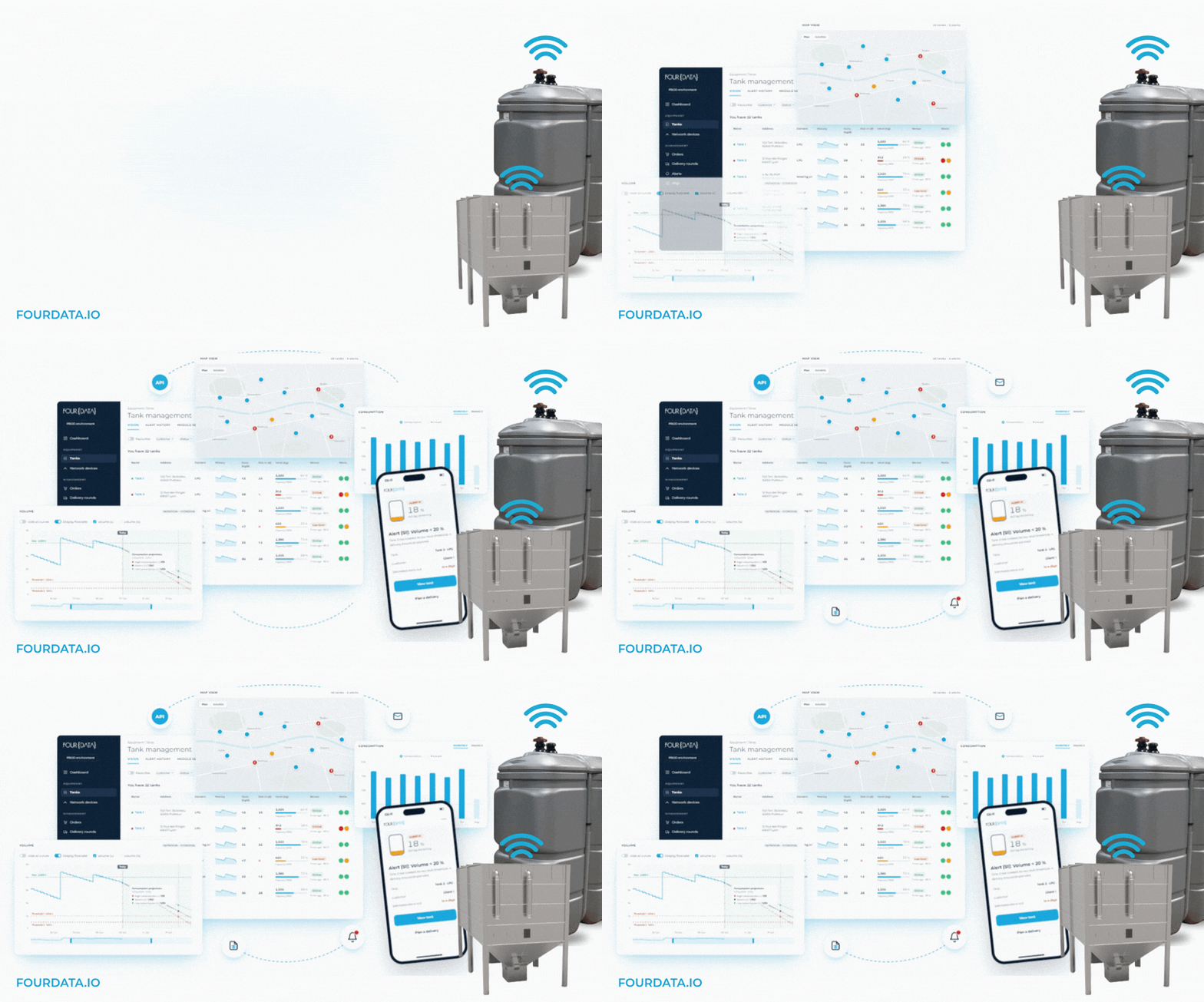
For fuel monitoring, pressure sensors measure the level of above-ground or buried tanks of heating oil, off-road diesel, diesel or AdBlue, and report data over NB-IoT, LTE-M, LoRaWAN or Sigfox depending on site coverage. The readings feed the Desk platform, where the operator views their fleet, sets alert thresholds and prepares routes from real levels. The Sens white-label interface gives the end client their own visibility.
FOUR DATA architecture — from the in-tank sensor to the route order, Desk (operator) and Sens (end client) platforms.
For depots and distribution platforms, the NOVA PRESSION offer centralises the supervision of several fuel reservoirs on a single site. Everything integrates with the distributor’s business system through an API, avoiding a proliferation of isolated tools.
Expert advice
We rank tanks by real days-of-autonomy, never by displayed level alone: a fuller but fast-consuming, distant tank comes before a low, stable, nearby one. It is this level × consumption × lead time crossing that turns a measurement into a route order.
FOUR DATA does not stop at fitting a connected gauge: the company links industrial sensors, low-power connectivity, SaaS supervision and field support to turn a level measurement into a delivery order.
Running a fleet of fuel tanks and want to prioritise it by real days-of-autonomy? Tell our teams about your case.
What measurement changes, with the numbers
A sensor’s value is judged not by its accuracy alone but by what it saves in operations. Our ROI model starts from a typical distributor: 100 monitored tanks, a fleet of 5 trucks, around thirty emergency deliveries a year.
The average sensor cost is around €250, for an annual subscription of €49.5 per sensor. By cutting emergency deliveries by about 70% and kilometres driven by roughly 10%, this model estimates close to €32,500 in annual savings, a payback around eleven months and about 13.5 tonnes of CO₂ avoided.
FOUR DATA ROI model — 100 monitored tanks, 5 trucks, ~30 emergency deliveries/year. Orders of magnitude (≈ 13.5 t CO₂ avoided), to recalibrate on each fleet.
These values remain an order of magnitude, to be recalibrated on each fleet’s real data before any commitment.
After: from reactive to prepared dispatching
- route built in the morning, off the calls that came in;
- manual readings, spreadsheet and the driver’s memory;
- half-empty trucks, emergency deliveries at ≈ €120;
- run-out discovered at the same time as the client.
- route built the day before from days-of-autonomy;
- alert thresholds ahead of the critical point;
- customer service that sees the order coming;
- decisions grounded in data, not habit.
Once the tanks are equipped, teams move from reactive to prepared dispatching. The route is built the day before from days-of-autonomy, not from the calls that come in that morning. Alert thresholds warn ahead of the critical point and cut reliance on manual checks. Customer service sees the order coming and communicates earlier.
This is not a promise that nothing will go wrong — a sensor does not fill tanks. It is about reducing uncertainty and giving dispatchers a reliable basis to decide, especially in the weeks when every litre of distillate counts.
Frequent mistake
Equipping tanks without rethinking the routing logic. Data is worthless if the route is still built out of habit: it is the ranking by autonomy, not the sensor alone, that saves the kilometres.
With close to 80,000 sensors deployed across Europe, on the fleets of distributors such as Antargaz Energies, Vitogaz, Dyneff and Picoty/Brétéché, FOUR DATA built its platforms around this prioritisation logic.
FAQ
Prioritise your fuel tanks by their real days-of-autonomy
FOUR DATA teams audit your fleet, identify the priority equipment and propose a sensor, connectivity and platform architecture fitted to your field constraints.
Article produced with the expertise of Quentin Gauthray, Key Accounts Manager France at FOUR DATA, who supports energy distributors on the logistics optimisation of their tank fleets.
You may also be interested in these articles :