Agricultural Tank Monitoring: Securing Your GNR During Harvest Season
Summary
- Why a GNR breakdown is so costly in the middle of harvest season
- GNR in 2026: Prices Under Pressure and Subsidies Extended Through the End of August
- Tank Monitoring: Checking GNR Levels Remotely
- The Case of the CUMA: A Shared Tank, Shared Visibility
- In practical terms, how do we implement this?
- FAQs
- Protecting Your Harvest, Tank by Tank
8-minute read · Updated June 25, 2026
Contents
- Why a GNR breakdown is so costly in the middle of harvest season
- GNR in 2026: Prices Under Pressure and Subsidies Extended Through the End of August
- Tank Monitoring: Checking GNR Levels Remotely
- The Case of the CUMA: A Shared Tank, Shared Visibility
- In practical terms, how do we implement this?
- FAQs
During harvest season, an empty GNR tank doesn’t just stop a tractor—it brings an entire harvesting operation to a standstill for several days of good weather. Fuel consumption skyrockets, the machines run from morning to night, and even the slightest oversight regarding fuel levels results in lost hours.
The situation in 2026 isn’t helping: due to tensions in the Middle East, non-road diesel prices remain high, and the government has extended its 15-centime-per-liter reimbursement through the end of August. Remote tank monitoring thus becomes as much a matter of organization as it is of cash flow, whether it involves a standalone operation or a shared, connected tank within a CUMA.
Key Figure
During harvest season, a farm often works 12 to 15 hours a day, and diesel fuel consumption can double compared to the rest of the year—making it the worst possible time to discover an empty tank.
Why a GNR breakdown is so costly in the middle of harvest season
The harvest window is short and depends on the weather. When conditions are right, GNR consumption spikes suddenly, and a tank that runs out without warning is more than just a minor setback.
A combine left idle due to a lack of fuel means a missed weather window, grain left in the field, and sometimes a decline in harvest quality. If the farm works with an agricultural contractor or shares its machinery through a CUMA, the domino effect also impacts the other members who were waiting for the equipment. Emergency fuel deliveries are available, but they rarely arrive quickly—and almost never at the best price.
Warning
The cost of a breakdown isn’t just the higher fuel costs incurred during repairs: it’s the disruption to harvest schedules and the downtime for the machines—which is difficult to make up for once the weather window closes.
Over the course of a campaign, those few hours lost to emergency refueling quickly add up, especially when the same tank supplies multiple job sites throughout the day. The challenge, therefore, isn’t simply to “check” the tank level out of curiosity: it’s aboutplanning refueling early enough to ensure the level never drops below the critical threshold at the worst possible time of the year.
GNR in 2026: Prices Under Pressure and Subsidies Extended Through the End of August
Disruptions to oil shipments caused by tensions in the Middle East have driven up fuel prices, including those of GNR. To limit the impact on businesses, the government introduced emergency aid and subsequently extended it.
Specifically, following an initial subsidy of 3.86 centimes per liter on April deliveries, Decree No. 2026-477 of June 10, 2026, extends a reimbursement of 15 centimes per liter of agricultural GNR for the months of May, June, July, and August 2026. The measure takes the form of an invoice-based reimbursement: the farmer pays the amount up front at the time of purchase, then submits a claim via the Chorus Pro portal based on the actual number of liters delivered. The reduced excise tax rate specific to agricultural work, meanwhile, remains in effect permanently.
Note
Since reimbursement is calculated per liter and based on invoices, keeping an accurate record of your GNR consumption is no longer just a matter of planning your refueling routes—it’s also what ensures your subsidy claim is approved.
For details on the conditions and limits, the Ministry of Agriculture publishes information on all programs at agriculture.gouv.fr, and the complete tax rules for the agricultural GNR are detailed in our dedicated article.
Tank Monitoring: Checking GNR Levels Remotely
A connected tank operates on a simple chain: a sensor measures the level, connectivity transmits the data, and a platform displays it. FOUR DATA designs and manufactures each of these components, with nearly 80,000 sensors currently deployed across Europe.
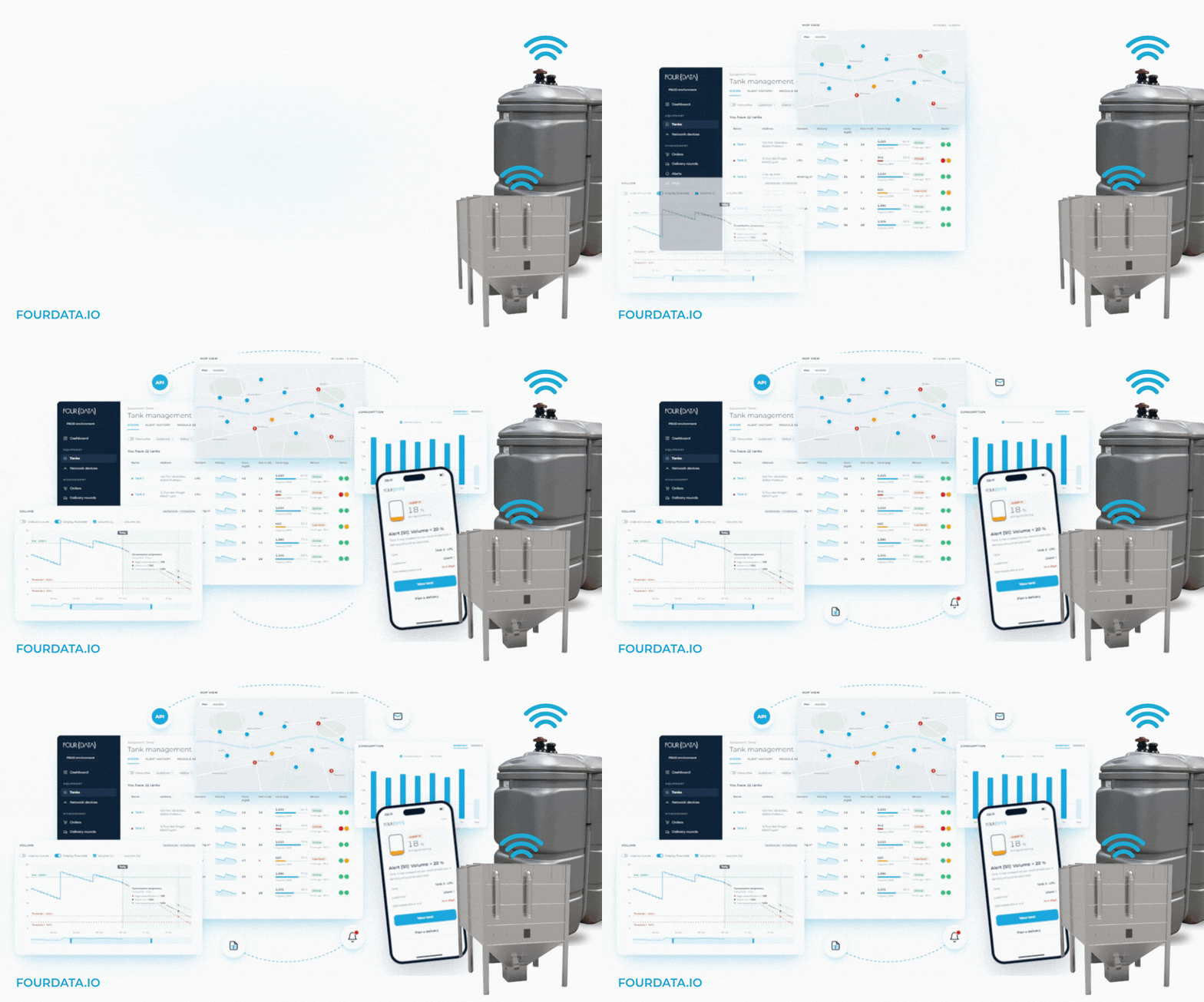
FOUR DATA Tank Monitoring System — From the Sensor on the Tank to the Alert on Your Phone
For GNR monitoring, the NOVA PRESSION pressure sensor is designed for both operational tanks larger than 5,000 liters and mobile container-type tanks. It is compatible with diesel, GNR, heating oil, and AdBlue, and transmits its measurements via LTE-M and NB-IoT networks, two technologies well-suited for rural areas where coverage is often less dense.
NOVA PRESSION FOUR DATA Sensor — Specifications and Installed Base in Europe
The choice of technology matters. On a GNR tank, a pressure sensor calculates the liquid level based on the weight of the column, making it reliable even on horizontal tanks or mobile containers moved from one plot to another. A non-intrusive ultrasonic sensor is suitable for other applications but is more susceptible to foam and irregular tank walls.
Expert Tip
For fuel in field tanks, we recommend pressure-based measurement: it offers the best balance between accuracy and tolerance to field conditions, particularly for horizontal tanks and mobile containers that are moved from one field to another.
Beyond simply measuring, two features make a real difference during harvest season. Configurable alerts notify you as soon as a low threshold is reached, giving you time to schedule a refueling before running out of fuel. The range module estimates, based on observed consumption, how many days’ worth of GNR remains in the tank. This shifts the approach from visual checks—with a dipstick in hand and a flashlight—to a forecast that helps prevent fuel shortages rather than reacting to them.
Do you manage multiple GNR tanks or a storage facility on your farm? Let’s discuss your GNR tank monitoring project: our teams will evaluate the solution best suited to your on-site conditions.
The Case of the CUMA: A Shared Tank, Shared Visibility
In many CUMA cooperatives, fuel is shared just like the machinery: a common tank supplies the equipment used in turn by several members. The system is cost-effective, but it creates a gray area. Who used how much? Who’s in charge of refueling? And no one wants to be the one who finds the tank empty on a Sunday during harvest season, right before their scheduled time slot.
This is precisely where the Desk and Sens platforms provide a practical solution through detailed management of accounts and permissions.
So everyone is looking at the same data, in near real time, through a central interface. The manager oversees the entire system on the Desk platform; members check their tanks on the Sens portal. Each member sees the drop in level corresponding to their own withdrawals, and the manager has access to a consolidated history to allocate the costs.
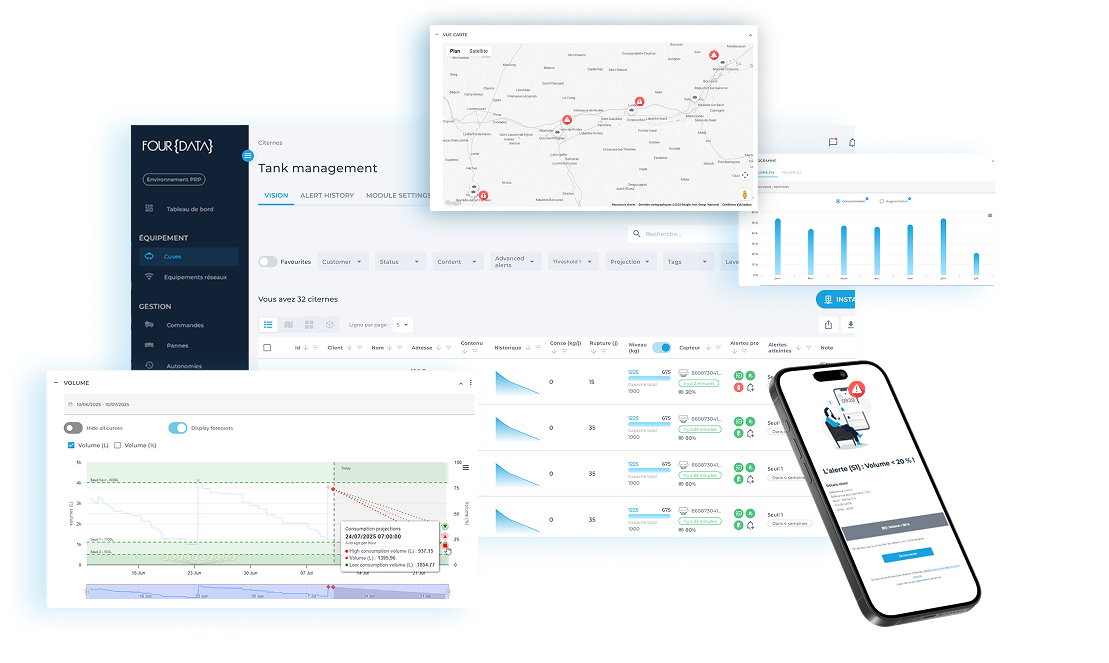
This transparency regarding consumption also makes it easier to allocate costs among members—an issue that is often contentious when a tank is shared. Internal billing is then based on shared data rather than estimates, which reduces disputes at the end of the season.
Advantage in brief
Shared visibility instead of a phone call to the neighbor — the common tank is no longer emptied behind anyone’s back, and each member retains control over what concerns them.
In practical terms, how do we implement this?
The deployment is approached as a project rather than simply delivering equipment. The implementation process consists of four stages:
- Needs assessment and on-site network coverage testing — an important step in rural areas to verify that LTE-M or NB-IoT signals reach the exact location of the tank.
- Installation of the sensor on the existing tank, without replacing the existing equipment.
- Create Desk and Sens accounts, assign permissions based on roles, and configure alert thresholds based on usage patterns.
- Support through technical assistance and, if needed, training via the Four Data Academy to help each user get up to speed with the interface.
For a CUMA, this initial setup is what transforms an isolated tank into a shared resource: it defines who can see what, who is notified, and who initiates the refueling process.
FAQs
Protecting Your Harvest, Tank by Tank
The harvest accounts for a significant portion of annual GNR consumption within just a few weeks, at a time when prices remain high and government subsidies are calculated per liter. Monitoring tanks remotely, planning refueling in advance, and sharing visibility among members of a CUMA addresses all three of these challenges at once. FOUR DATA supports farms, CUMA cooperatives, and agricultural contractors throughout the entire project, from selecting sensors to getting started with the Desk and Sens platforms.
Tell us about your setup and the number of devices you need to connect—our teams will recommend the IoT configuration best suited to your operation.
This article was written with the expertise of Quentin Gauthray, Key Account Manager for France at FOUR DATA—he supports farms, agricultural cooperatives (CUMA), and agricultural contractors with their GNR tank monitoring and data-driven management projects.
You may also be interested in these articles :