
What is the average price of fuel today?
Summary
7-minute read · Published on June 12, 2026 · Updated on June 12, 2026 at 4:48 p.m.
This article was written with the expertise of François Clément, Sales Director at FOUR DATA—which helps fuel distributors monitor their tanks and storage facilities.
According to the European oil report from late May 2026, fuel prices currently stand at around €2.10 per liter for diesel and €2.11 for SP95 on a national average. Behind these averages, the price difference between two gas stations in the same metropolitan area regularly exceeds 15 cents per liter —more than €9 on a 60-liter fill-up.
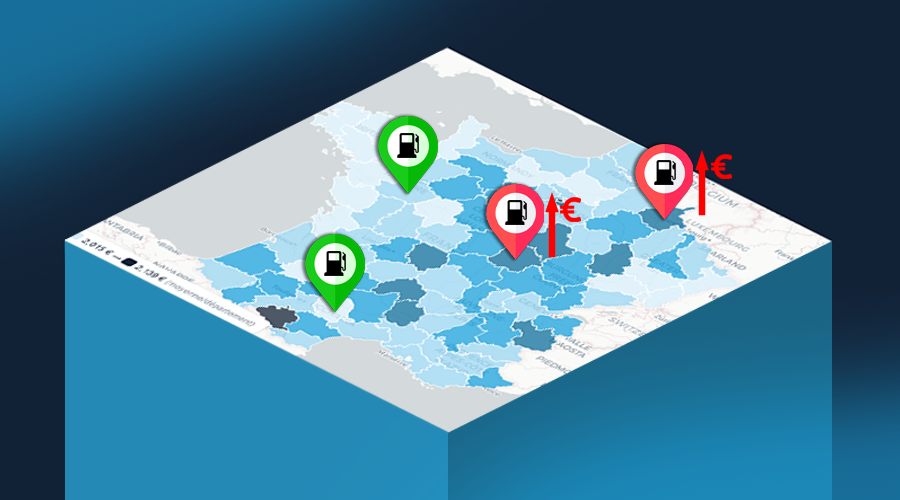
The map below displays the price of each fuel, station by station, based on official reports submitted to the DGCCRF, with data updated every 10 minutes. It also indicates current fuel shortages, a metric that has been closely monitored since the closure of the Strait of Hormuz in late February 2026 and the tensions in April.
Prices reported by distributors — Source: Ministry of Economy / DGCCRF, feed updated every 10 minutes (Open License 2.0). France view: average price per department. Zoom in to display stations.
How to use this map
When the map opens, it displays the whole of France along with the average price per department: the darker the shade of blue, the more expensive the selected fuel is in that area. When you zoom in on a city or a route, the view automatically switches to show actual gas stations, one by one. Clicking on a station opens its details: address, prices for all fuels sold, and any out-of-stock items.
-
- Selecting fuel (diesel, SP95, E10, SP98, E85, LPG): the color scheme and legend are recalculated.
-
- Zoom in on a department to switch from the average to individual stations, or click directly on a department.
-
- 📍 “Near Me ” centers the map on your location to show nearby stations.
-
- ⚠ “Out of Stock ” shows only stations that have recently run out of the selected fuel; ⟳ reloads the data.
Today’s Key Figures
In June 2026, a liter of diesel will sell for an average of around €2.10 in France, while SP95-E10 will cost between €2.05 and €2.10; diesel has remained more expensive than gasoline since late February. On the highway, the usual surcharge ranges from 10 to 20 cents per liter, or an additional €5 to €10 per 50-liter fill-up.
The indicators below—average fuel prices, the gasoline-to-diesel price difference, potential savings per fill-up, highway surcharges, and current fuel shortages—are continuously recalculated based on official data every time this page is visited.
Average fuel prices in France today
Loading national average prices…
(shortages declared less than 30 days ago)
Indicators calculated live from the official feed of the DGCCRF / Ministry of Economy (Open License 2.0), updated every 10 minutes.
Shortages: Where is fuel in short supply today?
Spring 2026 served as a reminder that availability matters just as much as price. In late March, TotalEnergies’ “fixed-price” promotion—gasoline at €1.99 and diesel at €2.09 per liter—triggered a massive rush to the group’s gas stations. The result: 1,243 stations were out of diesel or SP95 as of March 31, representing about 12% of the national network, according to government data compiled by Carbu.com.
Key figure
At the peak on April 6, 2026, nearlyone in five gas stations in France was affected by a fuel shortage, before a gradual return to normal following the one-time release of strategic reserves.
One detail that most tracking websites overlook: a stockout does not mean a shortage. Official data distinguishes between two situations. A temporary shortage —the station’s tank is empty, and a restock is expected—is the true sign of tight supply.Discontinuation of sales (known as a permanent shortage) simply means that the station has stopped selling that fuel, often E85 or autogas.
Counting both together artificially inflates the “shortage” figures that are being reported. That is why the counter above only includes temporary shortages of gasoline and diesel reported within the last 30 days, broken down by region—and why the ⚠ button on the map applies the same filter.
Why does a station run out of stock?
Three factors come into play. The first is a surge in demand: aggressive promotions, a busy weekend at the start of the season, or panic buying as soon as a shortage is mentioned in the media—the episode in April 2026 is a classic example.
The second issue relates toupstream logistics: strikes at refineries, blocked distribution centers, and strain on trucking capacity. In such cases, the gas station is powerless to act, no matter how well it has planned ahead.
The third mechanism is less obvious but much more common: tank management. A station or depot tank whose level is known only through manual readings empties faster than expected as soon as demand deviates from the norm. The restocking order is placed too late, the carrier’s route is already set, and the station displays “pump closed” for 24 to 72 hours.
Note
: In early April 2026, the average duration of a fuel shortage reached 2.5 days —a timeframe that depends largely on the quality of the information available before the shortage began.
Where does this data come from?
All data displayed on this page is sourced from the “Fuel Prices” information system of the DGCCRF (Ministry of the Economy). The framework is established bythe ministerial decree of December 12, 2006: any station selling more than 500 m³ of fuel per year must report its prices whenever they change, as well as any out-of-stock situations and closures, on the official portal prix-carburants.gouv.fr.
These reports feed into an open data feed published every 10 minutes under the Open License 2.0, which our map and indicators access directly—without any intermediate processing or third-party sources. If a posted price differs from the price observed at the station, the discrepancy is reported to the official website, which forwards it to the relevant administrative authority.
Note
: Gas stations report their prices whenever there is an actual change at the pump; therefore, a posted price may be a few minutes or a few days old. The date of the update is listed on each station’s information sheet on the map.
FAQs
Tracking prices at the pump is the downstream part of the business. For a distributor of heating oil, GNR, or fuels, the real key metric remains tank levels —both their own and those of their customers. This is exactly what the sensors designed and manufactured by FOUR DATA measure, connected to a multi-site monitoring platform.
You may also be interested in these articles :