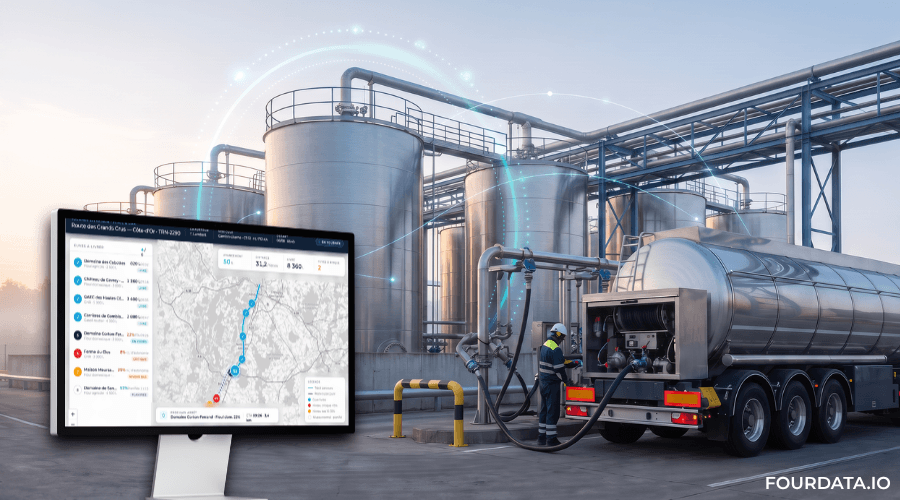

Veeder-Root, GIR: connect your PLC to FOUR DATA to control your isolated depots
Summary
- How do I connect an automatic gauging system to FOUR DATA?
- Iranian crisis, volatile Brent crude: why retailers’ margins are determined by the last penny
- Veeder-Root, GIR, ERLA, Tecalemit: established references, same blind spot
- The FOUR DATA method: an IoT retrofit connected to your PLC
- When there is no PLC: the FOUR DATA connected cabinet
- What you gain in concrete terms: three quantified levers
- FAQs
- Take control of your isolated depots
14 min reading – Published May 12, 2026 – Updated June 2, 2026
Article written with the expertise of François Clément, Sales Director at FOUR DATA – for over five years, FOUR DATA has been supporting multi-site deployments of connected sensors and PLCs by energy distributors and fleet managers.
Contents
Brent crude topped $119 a barrel in early May 2026, compared with $63 in October 2025. In seven months, the cost of buying a delivery has almost doubled. For a fuel oil distributor or fleet manager, every liter stocked at the wrong time will eat into the margin. Every shortage turns a customer into a complaint. And many operators are discovering that they control their most strategic depots with a Veeder-Root, GIR, ERLA or Tecalemit PLC installed ten years ago, which measures very well – but locally. The data remains on the console screen.
How do I connect an automatic gauging system to FOUR DATA?
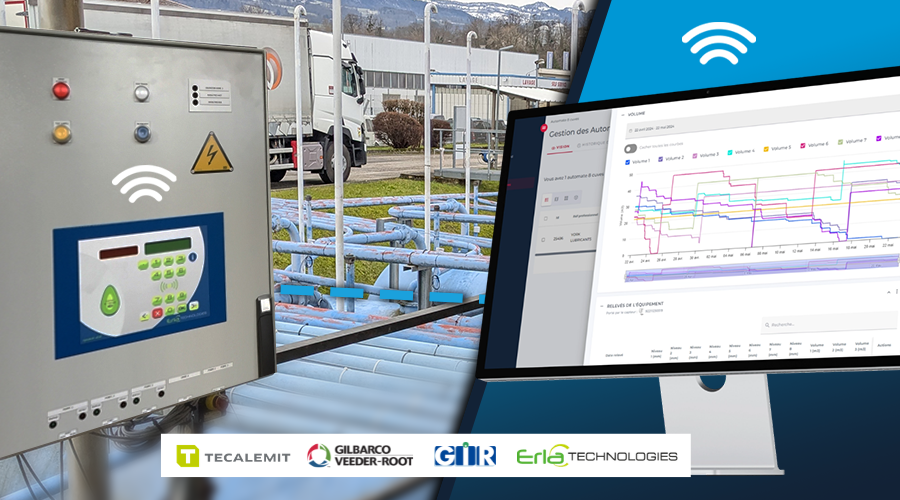
By connecting the communication output of your PLC – be it a Veeder-Root TLS, a GIR W150/W250/W400, an ERLA Epack/EpackWeb or a Tecalemit system – to a FOUR DATA module. The module reads levels, temperatures and alarms, and transmits them via the 4G network to the Desk platform. Your existing PLC retains its local gauging and compliance role. FOUR DATA adds multi-site supervision, mobile alerts and centralized logging, without replacing your existing hardware.
Key figure
Brent crude oil peaked at $119 a barrel in May 2026 (+89% since October 2025), before falling back to $96 in early June. On 100 m³ of fuel oil, the difference between a well and poorly calibrated supply exceeds €6,000 per tank.
Iranian crisis, volatile Brent crude: why retailers’ margins are determined by the last penny
Since the outbreak of the US-Israeli conflict with Iran in February 2026, the Strait of Hormuz has remained partially blocked. Approximately one-fifth of the world’s crude oil used to transit through this passage. Goldman Sachs has raised its forecast for average Brent crude in 2026 from $77 to $85, J.P. Morgan is talking about scenarios of $110 for the year, and UBS is modeling a trajectory of up to $150 in the event of prolonged blockage.
For a retailer, this Brent volatility is not a macro statistic. It’s a direct operational risk.
On 100 m³ of fuel oil bought in October, then resold in mid-May, the difference is over 6,000 euros per tank. The distributor who buys at peak, delivers slowly, or suffers a rupture that forces an emergency approach at the height of the shock – loses his margin directly. Conversely, those who can see their levels in real time on all their sites can arbitrate: fill before the next tremor, smooth out deliveries, pre-empt customer shortages of a few hours.
Field data becomes the raw material for steering. But it still has to leave the depot’s technical room.
Veeder-Root, GIR, ERLA, Tecalemit: established references, same blind spot
Many fuel depots and private stations are already equipped. Not with nothing, but with reliable reference automats, some of which have been in place for ten or fifteen years.
Veeder-Root (Gilbarco Veeder-Root Group) is the world standard in electronic gauging. More than half a million TLS-200, TLS-250, TLS-350, TLS-4 and TLS-450 PLUS consoles are installed worldwide. The equipment measures levels using magnetostrictive probes, manages up to 64 probes depending on the model, detects leaks, monitors the presence of water in underground tanks, and triggers local high and low threshold alarms. On a touch screen or via a local web interface, the operator sees everything. But the interface stops at the door.
GIR is the recognized French player in private fuel station management. Its full-web solution controls driver and vehicle access terminals using badges, authorizes refueling, records every transaction and feeds a SaaS cloud platform. On the tank inventory side, the W150, W250 and W400 PLCs incorporate an electronic gauge – but multi-site centralization and integration with the distributor’s IoT supervision platforms often remain to be built.
Two other ecosystems are also widely deployed in France and Europe. ERLA Technologies, a French manufacturer, equips numerous depots and private stations with its Epack range and EpackWeb software. And Tecalemit, a German specialist in fluid management, whose TECALEMIT Flow range is present in industrial depots and utility fleets.
The conclusion is clear. This equipment does its job well – local measurement and regulatory compliance. But three functions are almost always missing:
- consolidated view of a fleet of 5, 20 or 100 depots
- mobile push alerts to the operations manager, not just the local siren
- open API to the distributor’s ERP, so that the tank level triggers logistics planning without human intervention
Replacing a Veeder-Root TLS-450, a GIR W400 terminal, an ERLA Epack or a Tecalemit Flow to gain these functions makes no sense. The equipment is amortized, certified and operational. The logic is that of retrofit: adding a layer of IoT feedback on top of what already exists.
The FOUR DATA method: an IoT retrofit connected to your PLC
Our technicians connect the FOUR DATA module to your PLC using one of three methods, depending on the configuration installed. The existing management system retains its local gauging role and regulatory compliance.
1. Digital serial link. Most Veeder-Root TLS consoles, GIR PLCs and ERLA Epack / EpackWeb systems feature an RS-232 serial port for data export. Our module connects to this port, reads the PLC protocol, translates the frames and transmits them to the Platform Desk via the 4G network. Levels and alarms are reported hourly, or more frequently depending on the settings required.
2. Recovery of relays and dry contacts. If your PLC has only on/off outputs – high limit alarm, low limit alarm, overflow protection – we recover these contacts to report critical events in near-real time. Local supervision remains autonomous; FOUR DATA adds a centralized alert layer and time-stamped traceability.
3. Parallel sensor or analog signal. For older, non-compatible or proprietary gauges, there are two options. Either we recover the analog signal directly from the existing gauge – the most economical solution when available. Or we install a dedicated FOUR DATA gauge (TEK822 pressure, NOVA Pressure, or TEK811 ultrasound, depending on the fluid) in parallel with the existing probe. In both cases, your console retains its conformity, and you recover the connected data for remote control.
Today’s compatible ecosystem
The FOUR DATA module interfaces with the majority of automatic gauging and management systems installed in France and Europe:
- Veeder-Root – TLS-200, TLS-250, TLS-350, TLS-4 and TLS-450 PLUS consoles
- GIR – W150, W250 and W400 controllers
- ERLA Technologies – Epack / EpackWeb range of PLCs and software (French manufacturer, erla.fr)
- Tecalemit – fluid management systems, including the TECALEMIT Flow range(tecalemit.de)
Other field-installed systems – Hectronic, MPS, proprietary historical PLCs – are regularly integrated on a case-by-case basis. Thecompatibility audit takes just 5 working days, based on a photo of your installation, the PLC model and a sample export template. On-site physical connection then takes less than half a day, with no interruption to service.
Expert advice
Before considering the complete replacement of a fleet of PLCs, we recommend a one-off compatibility audit at two or three pilot sites. In 90% of cases, the existing serial link or dry contact is sufficient – the investment is reduced from several tens of thousands of euros to a simple add-on module + platform subscription.
Soon to be compatible
Our technical teams are currently working on the integration of the following ecosystems, which will be natively supported in the coming quarters:
- TSG (Technical Services and Solutions) – ProFleet’s DiaLOG management system and Station Manager 365 platform
- Madic (formerly LAFON) – EASYCARB controller and EASYCONNECT supervision software
- ALX Technologies – ALX 308, ALX 402, ALX 602 and ALX 808 management terminals
Note
If your depot is equipped with one of these systems, let us know when you request an audit: we’ll let you know when the integration will open, and in the meantime, we can offer you a parallel sensor connection so you don’t have to wait.
When there is no PLC: the FOUR DATA connected cabinet
Not every single depot has inherited a Veeder-Root, GIR, ERLA or Tecalemit. In the case of secondary platforms, rental sites, construction sites or recent distribution depots, it is often necessary to start from scratch. In these cases, FOUR DATA has designed a connected cabinet capable of simultaneously managing from 1 to 50 probes, designed for the industrial environment and ATEX-compatible via a dedicated barrier.
Measurements are displayed instantly on the integrated screen. Data is transmitted 24 times a day by default, i.e. every hour, to the Desk platform via 4G network. Customized settings are possible – increased frequency, transmission windows, thresholds per tank.
Four optional functions are worth mentioning in greater detail, as they correspond to very specific use cases on isolated depots and ICPE sites.
Attention
In ATEX classified areas, the separation of Ex and non-Ex zones is non-negotiable. Our cabinet incorporates an intrinsically safe barrier (Ex ia) on the sensor side; the communication module remains in the non-Ex zone. Any other configuration will result in commissioning being refused by the ICPE inspector.
Flashing beacon and siren option
On a 40,000-liter tank, a high threshold is typically set at 39,500 liters. When the delivery arrives and this threshold is reached, the flashing light comes on and the siren goes off: the driver knows, without needing to monitor a remote screen, that he must stop filling. An acknowledgement button on the cabinet cuts the signal after confirmation. This avoids overfilling, which with a product like RNG or fuel oil generates pollution, loss of product and the need to clean up pollution.
Gate blocking on weir
The cabinet controls relay outputs which can operate an inlet or outlet solenoid valve. In the event of a high alert, the inlet is cut off to prevent any overflow, even if the operator does not react. In the event of a low alert, the outlet is cut off to preserve the minimum technical level of the tank, protect the pumps against air suction, and mechanically trigger replenishment.
Instant readout on PLC
The touch screen continuously displays the volume, fill percentage, height and thresholds configured for each tank under management. The local operator retains direct visual control, independent of the cellular network and cloud platform.
Sentinel option
Sentinel mode accelerates the frequency of readings as soon as an abnormal variation is detected: sudden drop in level outside a delivery time window, continuous loss measured over a few hours, gap between redundant tanks. In concrete terms, this is the option that protects against fuel theft from unguarded depots, and against slow leaks that go undetected during a conventional reading. The data changes from one point per hour to one point every few minutes, the time needed to characterize the event and sound the alarm.
The cabinet is included in the FOUR DATA catalog as part of our depot offer, alongside the NOVA Pressure sensor for underground and overhead tanks (fuels, GNR, B100, oils, additives).
What you gain in concrete terms: three quantified levers
On a typical fleet – a fuel distributor equipping 100 customer tanks with 5 trucks and 30 emergency deliveries per year – our deployments generate on average :
Data from a typical profile: fuel distributor, 100 customer tanks, fleet of 5 trucks at 30,000 km/year
But the real leverage in 2026 goes beyond these operational figures. With Brent crude at $119, which can fall back to $90 and then rise again to $130 in the space of a few weeks, maintaining margins depends on the precision with which purchases are aligned with actual fleet levels. A distributor who sees the levels of its 40 depots and 200 customer tanks on the same chart arbitrates its purchase orders differently. He avoids overstocking at peak times. He avoids stock-outs when the market turns. He no longer pilots blindly.
This is the result of connecting a Veeder-Root, GIR, ERLA or Tecalemit PLC to the FOUR DATA platform. Not a revolution. It’s just a way of putting the data that lies dormant in your technical premises back into circulation.
FAQs
Take control of your isolated depots
If you operate several sites equipped with Veeder-Root, GIR, ERLA, Tecalemit, or any other automatic gauge, and the data doesn’t leave the premises, you probably already have the necessary infrastructure. All that’s missing is the data feed and centralization layer.
Our teams check the model installed, identify the most appropriate connection method (serial link, dry contact, parallel sensor), and send you a costed diagram. François Clément and the Key Accounts France team are your points of contact.
You may also be interested in these articles :